Weekly Information about Bright Comets (2025 Dec. 13: South)
|
Japanese version Home page |
Updated on December 20, 2025 |
|||
|
||||
|
Best time and the azimuth, altitude (A,h) are at lat. 35 deg in the Southern Hemisphere. Azimuth indicates 0 for south, 90 for west, 180 for north, 270 for east. |

|

|
Now it is 10.7 mag (Dec. 18, Osamu Miyazaki). It brightens up to 8 mag, but it will turn to fade out rapidly after that. In the Northern Hemisphere, it stays observable in good condition. In the Southern Hemisphere, it will be getting higher gradually. Date(TT) R.A. (2000) Decl. Delta r Elong. m1 Best Time(A, h) Dec. 13 11 18.10 17 51.8 0.628 1.234 97 9.1 2:53 (226, 22) Dec. 20 11 52.93 16 43.1 0.609 1.211 96 8.7 2:55 (228, 22) |
 C/2025 A6 ( Lemmon )
|
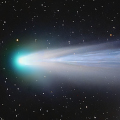
It brightened up to 3.7 mag in late October (Oct. 26, Juan Jose Gonzalez). Fading rapidly. Now it is not observable. It will appear soon in the Southern Hemisphere. Date(TT) R.A. (2000) Decl. Delta r Elong. m1 Best Time(A, h) Dec. 13 17 12.48 -32 38.2 1.884 0.928 9 9.4 2:53 (322,-10) Dec. 20 17 12.33 -35 13.9 1.967 1.044 14 10.3 2:55 (319, -4) |
C/2024 E1 ( Wierzchos )
|
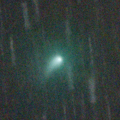
It was originally expected to brighten up to 5 mag in January. But actually, the brightness evolution is slower than originally expected. It will be 8 mag at best. Now it is 9.6 mag (Dec. 10, Mike Olason). It brightens up to 7.5 mag, but it will turn to fade out rapidly after that. Now it is not observable. It will appear in January in the Southern Hemisphere, or in February in the Northern Hemisphere. Date(TT) R.A. (2000) Decl. Delta r Elong. m1 Best Time(A, h) Dec. 13 18 7.20 -13 56.7 1.928 1.005 14 10.4 20:54 ( 58,-17) Dec. 20 18 25.75 -18 13.8 1.849 0.894 9 10.0 20:59 ( 52,-17) |
C/2025 T1 ( ATLAS )

|
Now it is 9.8 mag (Dec. 18, Osamu Miyazaki). It will fade out rapidly after this. In the Northern Hemisphere, it will be getting lower gradually after this, and it will be unobservable in January. In the Southern Hemisphere, it is not observable now, but it will appear in March. Date(TT) R.A. (2000) Decl. Delta r Elong. m1 Best Time(A, h) Dec. 13 19 55.22 11 25.6 1.433 1.122 51 10.3 20:54 ( 95,-12) Dec. 20 20 13.48 5 56.4 1.595 1.145 45 10.7 20:59 ( 89,-12) |
210P/Christensen

|
It brightened up to 9.5 mag in late November (Nov. 28, Michael Jager, Gerald Rhemann, E. Prosperi). Now it is 11.6 mag (Dec. 18, Osamu Miyazaki). Fading rapidly. It will be fainter than 18 mag in March. It will be getting higher gradually. Date(TT) R.A. (2000) Decl. Delta r Elong. m1 Best Time(A, h) Dec. 13 14 32.95 -8 54.5 0.852 0.676 42 10.9 2:53 (279, 2) Dec. 20 14 45.22 -8 32.2 0.950 0.770 46 11.9 2:55 (277, 6) |
3I/2025 N1 ( ATLAS )

|
Third interstellar object in history following 1I/'Oumuamua and 2I/Borisov. The eccentricity is extremely big as 6. It approached to Sun down to 1.38 a.u. in late October. It brightened up to 8.9 mag in November (Nov. 12, Toshiyuki Takahashi). Now it is 11.2 mag (Dec. 18, Osamu Miyazaki). Fading rapidly. It will be fainter than 18 mag in March. It stays observable in good condition. Date(TT) R.A. (2000) Decl. Delta r Elong. m1 Best Time(A, h) Dec. 13 11 14.31 4 40.1 1.813 2.111 93 11.2 2:53 (236, 33) Dec. 20 10 42.57 7 23.8 1.798 2.309 108 11.8 2:55 (219, 40) |
240P/NEAT
|
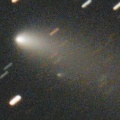
Now it is 12.1 mag (Dec. 16, Osamu Miyazaki). Fading gradually. In the Northern Hemisphere, it stays observable in good condition. In the Southern Hemisphere, it will be getting lower gradually. The component B is brightening rapidly. Now it is bright as 14.3 mag (Dec. 7, Andrew Pearce). Date(TT) R.A. (2000) Decl. Delta r Elong. m1 Best Time(A, h) Dec. 13 3 27.49 11 11.6 1.209 2.122 150 12.2 21:58 (180, 44) Dec. 20 3 22.83 13 1.2 1.249 2.122 143 12.2 21:26 (180, 42) |
88P/Howell

|
It will brighten rapidly after this. It stays extremely low in the Northern Hemisphere. But it will become high in summer. In the Southern Hemisphere, it is not observable now, but it will appear in January. Date(TT) R.A. (2000) Decl. Delta r Elong. m1 Best Time(A, h) Dec. 13 15 53.71 -19 52.3 2.587 1.699 20 12.8 2:53 (300, -6) Dec. 20 16 14.63 -21 0.9 2.524 1.658 22 12.5 2:55 (299, -4) |
C/2025 R2 ( SWAN )
|
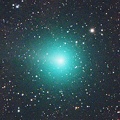
It brightened up to 5.2 mag in October (Oct. 11, Virgilio Gonano). Now it is 12.9 mag (Dec. 18, Toru Yusa). Fading rapidly. It will be fainter than 18 mag in March. In the Northern Hemisphere, it stays observable in good condition. In the Southern Hemisphere, it will be getting lower gradually. Date(TT) R.A. (2000) Decl. Delta r Elong. m1 Best Time(A, h) Dec. 13 0 30.11 9 44.3 1.265 1.847 109 12.7 20:54 (144, 38) Dec. 20 0 41.76 10 35.2 1.441 1.952 105 13.3 20:59 (139, 34) |
C/2025 K1 ( ATLAS )
|
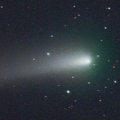
It brightened up to 9.3 mag in November (Nov. 2, Virgilio Gonano). Now it is 12.6 mag (Dec. 11, Osamu Miyazaki). Fading rapidly. It will be fainter than 18 mag in February. In the Northern Hemisphere, it stays observable in good condition. In the Southern Hemisphere, it will be unobservable in February. The nucleus is split into three components. Date(TT) R.A. (2000) Decl. Delta r Elong. m1 Best Time(A, h) Dec. 13 1 16.92 52 20.3 0.723 1.525 125 12.8 20:54 (170, 2) Dec. 20 1 2.34 44 57.9 0.929 1.645 118 13.7 20:59 (160, 6) |
235P/LINEAR

|
It became brighter than expected. Now it is 13.5 mag (Nov. 29, Ken-ichi Kadota). It stays 13 mag for a while. It locates somewhat low in the Northern Hemisphere. But it will become high in spring. In the Southern Hemisphere, it will be getting higher gradually. Date(TT) R.A. (2000) Decl. Delta r Elong. m1 Best Time(A, h) Dec. 13 13 52.60 -13 17.3 2.463 1.980 50 13.3 2:53 (277, 13) Dec. 20 14 8.48 -14 18.4 2.405 1.978 53 13.3 2:55 (276, 16) |
C/2022 N2 ( PanSTARRS )

|
Now it is 13.0 mag (Dec. 16, Osamu Miyazaki). Fading slowly. In the Northern Hemisphere, it stays observable in good condition. It locates somewhat low in the Southern Hemisphere. Date(TT) R.A. (2000) Decl. Delta r Elong. m1 Best Time(A, h) Dec. 13 3 13.64 25 12.5 3.112 4.003 151 13.5 21:45 (180, 30) Dec. 20 3 12.36 24 58.2 3.184 4.021 143 13.6 21:16 (180, 30) |
29P/Schwassmann-Wachmann 1
|
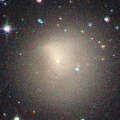
It brightened in outburst on Dec. 5. Now it is 12.6 mag (Dec. 18, Osamu Miyazaki). It stays observable in good condition. Date(TT) R.A. (2000) Decl. Delta r Elong. m1 Best Time(A, h) Dec. 13 11 31.94 -2 35.4 6.291 6.304 86 14.0 2:53 (245, 35) Dec. 20 11 33.25 -2 54.0 6.177 6.305 92 14.0 2:55 (240, 40) |
C/2022 QE78 ( ATLAS )
|
Now it is 14.4 mag (Nov. 29, Purple Mountain Observatory, XuYi Station). It stays 15 mag for a while. In the Northern Hemisphere, it stays observable in good condition. It locates somewhat low in the Southern Hemisphere. Date(TT) R.A. (2000) Decl. Delta r Elong. m1 Best Time(A, h) Dec. 13 9 27.01 22 28.0 4.913 5.518 123 14.4 2:53 (198, 30) Dec. 20 9 27.03 23 7.9 4.832 5.525 130 14.3 2:55 (191, 31) |
C/2021 G2 ( ATLAS )

|
Now it is 14.4 mag (Oct. 11, Hiroshi Abe). It stays 15 mag for a while. In the Northern Hemisphere, it will be getting higher gradually. In the Southern Hemisphere, it is not observable now, but it will appear in January. Date(TT) R.A. (2000) Decl. Delta r Elong. m1 Best Time(A, h) Dec. 13 16 35.22 -0 37.1 6.955 6.077 25 14.8 2:53 (292,-27) Dec. 20 16 40.78 -0 21.6 6.951 6.107 28 14.8 2:55 (287,-22) |
C/2025 L1 ( ATLAS )

|
It is expected to brighten up to 13.5 mag and to be observable in good condition in 2026 spring. Brightening slowly. In the Northern Hemisphere, it is not observable now, but it will appear in January. In the Southern Hemisphere, it will be getting higher gradually. Date(TT) R.A. (2000) Decl. Delta r Elong. m1 Best Time(A, h) Dec. 13 15 25.89 -42 23.4 2.502 1.728 30 14.9 2:53 (314, 12) Dec. 20 15 33.51 -40 39.0 2.440 1.709 33 14.8 2:55 (310, 15) |
C/2024 J3 ( ATLAS )

|
It will brighten up to 13 mag in 2026. Now it is 14.9 mag (Nov. 17, Alfons Diepvens). Brightening slowly. In the Northern Hemisphere, it will be unobservable temporarily in January. In the Southern Hemisphere, it is not observable now, but it will appear in February. Date(TT) R.A. (2000) Decl. Delta r Elong. m1 Best Time(A, h) Dec. 13 19 1.34 -6 13.5 5.708 4.877 29 14.9 20:54 ( 73,-13) Dec. 20 19 6.19 -5 33.8 5.712 4.842 25 14.8 20:59 ( 69,-19) |
C/2024 T5 ( ATLAS )

|
Now it is 14.5 mag (Dec. 15, ATLAS Chile). It stays 15 mag for a while. In the Northern Hemisphere, it will be unobservable in March. In the Southern Hemisphere, it stays observable in good condition. It is expected to brighten up to 11 mag in winter between 2026 and 2027. Date(TT) R.A. (2000) Decl. Delta r Elong. m1 Best Time(A, h) Dec. 13 2 41.41 -43 40.5 5.441 5.757 103 14.9 21:12 ( 0, 81) Dec. 20 2 38.88 -42 47.5 5.457 5.716 100 14.8 20:59 ( 23, 82) |
C/2014 UN271 ( Bernardinelli-Bernstein )
|
Very large comet. It is expected to brighten up to 13 mag in 2031. Now it is 14.3 mag (Nov. 22, Thomas Lehmann). It stays 15 mag for a while. In the Northern Hemisphere, it is not observable now. In the Southern Hemisphere, it stays observable in good condition. In the Northern Hemisphere, it is not observable until 2030. Date(TT) R.A. (2000) Decl. Delta r Elong. m1 Best Time(A, h) Dec. 13 5 12.87 -74 57.5 14.564 14.458 81 14.9 23:41 ( 0, 50) Dec. 20 5 7.71 -74 57.8 14.551 14.436 81 14.9 23:08 ( 0, 50) |
78P/Gehrels 2

|
It will brighten up to 12 mag in 2026 summer. Now it is 16.3 mag (Dec. 14, Catalina Sky Survey). Brightening gradually. It will be unobservable in January in the Southern Hemisphere, or in February in the Northern Hemisphere. Date(TT) R.A. (2000) Decl. Delta r Elong. m1 Best Time(A, h) Dec. 13 21 6.51 -11 56.2 2.956 2.520 54 15.2 20:54 ( 86, 16) Dec. 20 21 17.56 -11 19.2 2.998 2.489 50 15.1 20:59 ( 84, 11) |
C/2023 R1 ( PanSTARRS )

|
Now it is 15.3 mag (Dec. 4, Ken-ichi Kadota). It stays 15 mag for a while. In the Northern Hemisphere, it will be unobservable temporarily in January. In the Southern Hemisphere, it is not observable now, but it will appear in February. Date(TT) R.A. (2000) Decl. Delta r Elong. m1 Best Time(A, h) Dec. 13 19 15.81 -0 29.5 4.487 3.736 36 15.3 20:54 ( 80,-13) Dec. 20 19 17.54 -1 4.1 4.531 3.718 30 15.3 20:59 ( 74,-19) |
C/2024 R4 ( PanSTARRS )
|
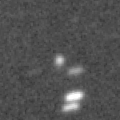
Brightening rapidly. It is expected to brighten up to 12 mag from 2027 to 2028. Now it is 16.0 mag (Nov. 17, Alfons Diepvens). It stays 16 mag for a while. In the Northern Hemisphere, it will be getting lower gradually. But it will be getting higher again after February. In the Southern Hemisphere, it will be unobservable temporarily in April. Date(TT) R.A. (2000) Decl. Delta r Elong. m1 Best Time(A, h) Dec. 13 21 29.36 20 58.0 7.111 6.921 74 16.0 20:54 (117, 1) Dec. 20 21 30.47 20 57.5 7.166 6.882 69 15.9 20:59 (112, -5) |
C/2022 E2 ( ATLAS )
|
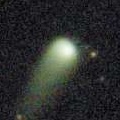
It was observed at 12-13 mag for a long time in 2024. Now it is 15.8 mag (Dec. 10, Ken-ichi Kadota). Fading slowly. In the Northern Hemisphere, it will be getting lower gradually. But it will be getting higher again after March. It stays extremely low in the Southern Hemisphere. But it will become high in autumn. Date(TT) R.A. (2000) Decl. Delta r Elong. m1 Best Time(A, h) Dec. 13 22 27.06 35 1.4 5.231 5.373 92 15.9 20:54 (135, 1) Dec. 20 22 27.67 33 46.8 5.375 5.415 87 16.0 20:59 (130, -3) |
C/2025 Q3 ( ATLAS )

|
Now it is 15.6 mag (Dec. 10, Hidenori Nohara). Fading slowly. In the Northern Hemisphere, it will be getting lower gradually after this, and it will be unobservable in March. In the Southern Hemisphere, it stays observable in good condition. Date(TT) R.A. (2000) Decl. Delta r Elong. m1 Best Time(A, h) Dec. 13 2 23.97 3 59.4 1.496 2.287 133 16.0 20:54 (180, 51) Dec. 20 2 15.58 -0 21.5 1.570 2.257 122 16.1 20:59 (162, 54) |
C/2022 R6 ( PanSTARRS )

|
Now it is 16.2 mag (Dec. 15, ATLAS South Africa). It stays 16 mag for a while. It stays observable in good condition. Date(TT) R.A. (2000) Decl. Delta r Elong. m1 Best Time(A, h) Dec. 13 8 57.82 -11 59.4 6.112 6.606 116 16.1 2:53 (203, 65) Dec. 20 8 56.72 -11 49.3 6.030 6.612 122 16.1 2:55 (185, 67) |
40P/Vaisala 1
|
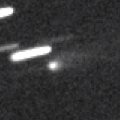
Now it is 15.4 mag (Dec. 4, Ken-ichi Kadota). It stays 17 mag for a while. In the Southern Hemisphere, it will be getting higher gradually. Date(TT) R.A. (2000) Decl. Delta r Elong. m1 Best Time(A, h) Dec. 13 14 32.77 -6 24.7 2.435 1.851 43 16.4 2:53 (277, 1) Dec. 20 14 50.13 -7 25.3 2.404 1.864 46 16.5 2:55 (276, 4) |
C/2023 C2 ( ATLAS )

|
It brightened up to 12.7 mag in 2024 summer (Aug. 7, 2024, Thomas Lehmann). Now it is 15.9 mag (Dec. 13, Alfons Diepvens). Fading slowly. In the Northern Hemisphere, it stays observable in good condition. In the Southern Hemisphere, it will never be observable after this. Date(TT) R.A. (2000) Decl. Delta r Elong. m1 Best Time(A, h) Dec. 13 22 35.00 49 45.8 4.387 4.669 100 16.4 20:54 (147, -9) Dec. 20 22 40.94 49 12.9 4.504 4.724 96 16.5 20:59 (143,-11) |
261P/Larson
|
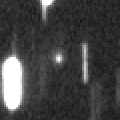
Now it is 16.2 mag (Dec. 14, Catalina Sky Survey). Fading slowly. It will be fainter than 18 mag in April. It will be unobservable in February in the Southern Hemisphere, or in April in the Northern Hemisphere. Date(TT) R.A. (2000) Decl. Delta r Elong. m1 Best Time(A, h) Dec. 13 21 46.24 -8 18.2 2.222 2.017 65 16.4 20:54 ( 95, 22) Dec. 20 22 0.25 -7 4.0 2.284 2.015 61 16.5 20:59 ( 94, 17) |
493P/2024 Q2 ( LONEOS )

|
Now it is 16.2 mag (Dec. 17, Yukihiro Sugiyama). It stays 17 mag for a while. In the Northern Hemisphere, it stays observable in good condition. It stays extremely low in the Southern Hemisphere. Date(TT) R.A. (2000) Decl. Delta r Elong. m1 Best Time(A, h) Dec. 13 4 43.84 53 47.4 2.954 3.828 148 16.5 23:15 (180, 1) Dec. 20 4 37.78 53 37.8 2.965 3.826 146 16.5 22:41 (180, 1) |
C/2024 A1 ( ATLAS )

|
Now it is 16.2 mag (Dec. 18, D. Buczynski). Fading slowly. In the Northern Hemisphere, it stays observable in good condition. In the Southern Hemisphere, it will be unobservable soon. Date(TT) R.A. (2000) Decl. Delta r Elong. m1 Best Time(A, h) Dec. 13 8 43.82 49 55.6 3.459 4.186 132 16.5 2:53 (184, 5) Dec. 20 8 36.62 52 14.6 3.432 4.209 137 16.5 2:44 (180, 3) |
145P/Shoemaker-Levy 5

|
Now it is 16.5 mag (Dec. 2, ATLAS Chile). It stays 17 mag for a while. In the Northern Hemisphere, it stays observable in good condition. In the Southern Hemisphere, it will be getting lower gradually after this, and it will be unobservable in March. Date(TT) R.A. (2000) Decl. Delta r Elong. m1 Best Time(A, h) Dec. 13 23 5.64 -8 42.0 1.796 1.945 83 16.5 20:54 (109, 38) Dec. 20 23 16.47 -6 46.7 1.852 1.931 79 16.5 20:59 (106, 32) |
C/2025 J1 ( Borisov )

|
Now it is 16.2 mag (Dec. 17, Yukihiro Sugiyama). It stays 16 mag for a while. In the Northern Hemisphere, it stays observable in good condition. In the Southern Hemisphere, it is not observable now. Date(TT) R.A. (2000) Decl. Delta r Elong. m1 Best Time(A, h) Dec. 13 10 8.62 78 10.3 3.397 3.933 116 16.6 2:53 (186,-24) Dec. 20 9 27.47 79 13.0 3.329 3.908 119 16.5 2:55 (182,-24) |
164P/Christensen
|
Now it is 16.8 mag (Dec. 4, Ken-ichi Kadota). Fading slowly. In the Northern Hemisphere, it stays observable in good condition. It locates somewhat low in the Southern Hemisphere. Date(TT) R.A. (2000) Decl. Delta r Elong. m1 Best Time(A, h) Dec. 13 11 16.15 20 40.7 2.109 2.461 98 16.6 2:53 (224, 20) Dec. 20 11 21.03 21 15.6 2.061 2.501 104 16.6 2:55 (219, 23) |
C/2023 H5 ( Lemmon )

|
Now it is 16.6 mag (Dec. 13, Alfons Diepvens). It stays 17 mag for a while. It locates somewhat low in the Northern Hemisphere. But it will become high in winter. In the Southern Hemisphere, it will never be observable after this. Date(TT) R.A. (2000) Decl. Delta r Elong. m1 Best Time(A, h) Dec. 13 17 25.63 62 59.0 4.483 4.524 86 16.7 20:54 (149,-50) Dec. 20 17 47.76 62 46.9 4.500 4.542 86 16.7 2:55 (211,-51) |
43P/Wolf-Harrington

|
Now it is 16.5 mag (Dec. 15, Alfons Diepvens). It stays 17 mag for a while. It stays observable in good condition. Date(TT) R.A. (2000) Decl. Delta r Elong. m1 Best Time(A, h) Dec. 13 11 2.12 -4 49.4 2.385 2.616 92 16.7 2:53 (241, 42) Dec. 20 11 6.99 -5 48.4 2.314 2.633 97 16.7 2:55 (236, 47) |
47P/Ashbrook-Jackson
|
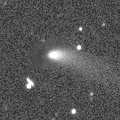
Now it is 16.4 mag (Nov. 27, Andrew Pearce). Fading slowly. It will be fainter than 18 mag in April. It will be getting lower gradually after this, and it will be unobservable in February in the Southern Hemisphere, or in March in the Northern Hemisphere. Date(TT) R.A. (2000) Decl. Delta r Elong. m1 Best Time(A, h) Dec. 13 23 2.49 -3 54.1 2.740 2.820 84 16.7 20:54 (112, 34) Dec. 20 23 9.19 -2 52.4 2.838 2.824 79 16.8 20:59 (108, 29) |
C/2023 F3 ( ATLAS )

|
Now it is 16.7 mag (Dec. 17, ATLAS Chile). It stays 17 mag for a while. It stays observable in good condition. Date(TT) R.A. (2000) Decl. Delta r Elong. m1 Best Time(A, h) Dec. 13 10 55.30 -24 44.8 5.686 5.698 85 16.8 2:53 (264, 55) Dec. 20 10 51.72 -24 50.8 5.589 5.720 92 16.8 2:55 (258, 62) |
195P/Hill
|
Now it is 16.9 mag (Nov. 22, Kunihiro Shima). It stays 17 mag for a while. It locates somewhat low in the Northern Hemisphere. In the Southern Hemisphere, it stays observable in good condition. Date(TT) R.A. (2000) Decl. Delta r Elong. m1 Best Time(A, h) Dec. 13 9 57.75 -28 52.3 4.278 4.479 95 16.9 2:53 (261, 68) Dec. 20 9 58.14 -29 55.5 4.202 4.484 100 16.8 2:55 (256, 74) |
C/2023 X2 ( Lemmon )

|
Now it is 17.0 mag (Nov. 29, Ken-ichi Kadota). It stays 17 mag for a while. In the Northern Hemisphere, it stays observable in good condition. In the Southern Hemisphere, it will never be observable after this. Date(TT) R.A. (2000) Decl. Delta r Elong. m1 Best Time(A, h) Dec. 13 16 15.33 85 34.0 4.686 5.090 108 16.8 2:53 (185,-37) Dec. 20 17 19.40 84 60.0 4.691 5.089 108 16.8 2:55 (185,-38) |
C/2025 R3 ( PanSTARRS )

|
It is expected to brighten up to 7 mag in April. Now it is 17.3 mag (Dec. 10, Purple Mountain Observatory, XuYi Station). It will brighten rapidly after this. It will be unobservable soon in the Southern Hemisphere, or in February in the Northern Hemisphere. But it will be observable again in March in the Northern Hemisphere, or in April in the Southern Hemisphere. At the high light, it is observable in the low sky before the perihelion passage in the Northern Hemisphere, or after the perihelion in the Southern Hemisphere. Date(TT) R.A. (2000) Decl. Delta r Elong. m1 Best Time(A, h) Dec. 13 22 22.83 24 13.6 2.229 2.394 87 17.0 20:54 (127, 8) Dec. 20 22 18.21 22 42.2 2.259 2.295 79 16.9 20:59 (120, 2) |
C/2023 RS61 ( PanSTARRS )
|
Although it is around 20 mag usually, now it is bright in outburst. Now it is 17.2 mag (Nov. 11, ATLAS-HKO, Haleakala). It stays 17 mag for a while. In the Northern Hemisphere, it stays observable in good condition. In the Southern Hemisphere, it will be unobservable in March. Date(TT) R.A. (2000) Decl. Delta r Elong. m1 Best Time(A, h) Dec. 13 2 46.90 37 34.9 7.985 8.803 144 17.0 21:18 (180, 17) Dec. 20 2 45.11 37 20.2 8.038 8.793 137 17.0 20:59 (178, 18) |
302P/Lemmon-PanSTARRS
|
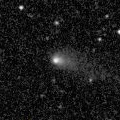
It brightened very rapidly, and it became brighter than expected. Now it is 16.5 mag (Dec. 18, A. Sankovich). Fading slowly. It will be fainter than 18 mag in February. In the Northern Hemisphere, it stays observable in good condition. In the Southern Hemisphere, it will be getting lower gradually. Date(TT) R.A. (2000) Decl. Delta r Elong. m1 Best Time(A, h) Dec. 13 0 21.70 -4 45.8 3.171 3.512 102 17.1 20:54 (130, 49) Dec. 20 0 24.70 -4 14.8 3.282 3.523 95 17.2 20:59 (123, 43) |
C/2019 E3 ( ATLAS )
|
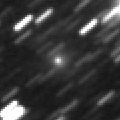
Very far object. Now it is 16.6 mag (Oct. 19, ATLAS Chile). It stays 17 mag for a while. In the Northern Hemisphere, it will be unobservable in January. In the Southern Hemisphere, it will be getting lower gradually. But it will be getting higher again after April. Date(TT) R.A. (2000) Decl. Delta r Elong. m1 Best Time(A, h) Dec. 13 0 6.45 -52 57.9 11.231 11.074 78 17.2 20:54 ( 43, 60) Dec. 20 0 5.41 -52 15.3 11.322 11.087 73 17.2 20:59 ( 47, 55) |
93P/Lovas 1
|
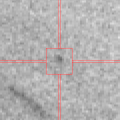
Now it is 18.1 mag (Dec. 8, Catalina Sky Survey). Brightening slowly. It will be unobservable in January in the Southern Hemisphere, or in March in the Northern Hemisphere. It will brighten up to 15.5 mag in spring. But it is not observable around the perihelion passage. Date(TT) R.A. (2000) Decl. Delta r Elong. m1 Best Time(A, h) Dec. 13 21 43.21 -12 2.7 2.455 2.194 63 17.4 20:54 ( 92, 23) Dec. 20 21 53.87 -10 42.5 2.488 2.153 58 17.3 20:59 ( 90, 18) |
48P/Johnson
|
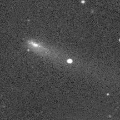
Now it is 16.5 mag (Dec. 14, ATLAS Chile). Fading gradually. It will be fainter than 18 mag in January. It stays observable in good condition. Date(TT) R.A. (2000) Decl. Delta r Elong. m1 Best Time(A, h) Dec. 13 3 12.28 3 30.7 2.021 2.872 143 17.3 21:43 (180, 51) Dec. 20 3 9.28 4 1.8 2.109 2.902 136 17.5 21:13 (180, 51) |
123P/West-Hartley

|
It will brighten up to 15 mag from autumn to winter in 2026. Now it is 17.6 mag (Dec. 14, Purple Mountain Observatory, XuYi Station). Brightening slowly. In the Northern Hemisphere, it stays observable in good condition. It locates somewhat low in the Southern Hemisphere. Date(TT) R.A. (2000) Decl. Delta r Elong. m1 Best Time(A, h) Dec. 13 3 35.68 27 10.2 2.044 2.971 156 17.4 22:06 (180, 28) Dec. 20 3 29.86 27 13.0 2.060 2.941 147 17.3 21:33 (180, 28) |
C/2024 X2 ( ATLAS )

|
Now it is 17.9 mag (Dec. 15, ATLAS South Africa). Fading slowly. It will be fainter than 18 mag in March. It stays observable in good condition. Date(TT) R.A. (2000) Decl. Delta r Elong. m1 Best Time(A, h) Dec. 13 9 10.60 -0 56.9 3.345 3.919 119 17.4 2:53 (203, 54) Dec. 20 9 4.63 0 24.2 3.260 3.940 127 17.3 2:55 (187, 55) |
(306173) 2010 NK83
|
|
Peculiar asteroid moving along a cometary orbit. Now it is 18.1 mag (Oct. 5, ATLAS-HKO, Haleakala). Fading slowly. It will be fainter than 18 mag in March. In the Northern Hemisphere, it stays observable in good condition. It locates somewhat low in the Southern Hemisphere. Date(TT) R.A. (2000) Decl. Delta r Elong. m1 Best Time(A, h) Dec. 13 8 7.80 20 54.8 1.679 2.523 141 17.5 2:42 (180, 34) Dec. 20 8 6.44 21 39.6 1.642 2.536 148 17.4 2:13 (180, 33) |
C/2017 K2 ( PanSTARRS )
|
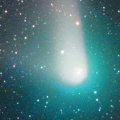
It brightened up to 8 mag from 2022 summer to 2023 spring. Now it is 17.0 mag (Dec. 1, Alfons Diepvens). It stays 18 mag for a while. In the Northern Hemisphere, it stays observable in good condition. It locates somewhat low in the Southern Hemisphere. Date(TT) R.A. (2000) Decl. Delta r Elong. m1 Best Time(A, h) Dec. 13 5 56.92 30 31.0 9.194 10.162 168 17.5 0:32 (180, 24) Dec. 20 5 53.41 30 39.1 9.234 10.210 172 17.5 0:01 (180, 24) |
217P/LINEAR

|
It brightened up to 12.1 mag in early summer (June 10, Taras Prystavski). Now it is 16.4 mag (Dec. 11, Hidenori Nohara). Fading gradually. It will be fainter than 18 mag in January. It stays observable in good condition. Date(TT) R.A. (2000) Decl. Delta r Elong. m1 Best Time(A, h) Dec. 13 9 16.78 13 38.9 1.883 2.561 123 17.6 2:53 (198, 40) Dec. 20 9 13.73 14 17.3 1.859 2.616 131 17.7 2:55 (188, 40) |
C/2019 U5 ( PanSTARRS )
|
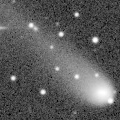
Now it is 17.2 mag (Nov. 26, Andrew Pearce). It stays 18 mag for a while. It stays extremely low in the Northern Hemisphere. In the Southern Hemisphere, it stays observable in good condition. Date(TT) R.A. (2000) Decl. Delta r Elong. m1 Best Time(A, h) Dec. 13 5 2.80 -47 53.0 8.363 8.731 108 17.6 23:32 ( 0, 77) Dec. 20 4 56.47 -47 42.4 8.424 8.775 107 17.7 22:59 ( 0, 77) |
C/2024 G2 ( ATLAS )

|
Now it is 17.8 mag (Nov. 14, W. Hasubick). It stays 18 mag for a while. It stays observable in good condition. Date(TT) R.A. (2000) Decl. Delta r Elong. m1 Best Time(A, h) Dec. 13 12 12.47 -11 17.1 5.710 5.516 73 17.7 2:53 (261, 32) Dec. 20 12 12.57 -10 50.9 5.599 5.528 80 17.7 2:55 (256, 38) |
276P/Vorobjov

|
Now it is 17.7 mag (Nov. 25, ATLAS-MLO, Mauna Loa). Fading slowly. It will be fainter than 18 mag in February. It stays observable in good condition. Date(TT) R.A. (2000) Decl. Delta r Elong. m1 Best Time(A, h) Dec. 13 7 1.13 5 0.8 3.344 4.223 149 17.7 1:36 (180, 50) Dec. 20 6 57.42 4 49.6 3.319 4.234 155 17.7 1:04 (180, 50) |
60P/Tsuchinshan 2
|
|
The condition of this apparition is bad. It must have brightened up to 16 mag in summer, but it was not observable. Fading gradually. It will be fainter than 18 mag soon. It locates somewhat low in the Northern Hemisphere. In the Southern Hemisphere, it will be getting higher gradually. Date(TT) R.A. (2000) Decl. Delta r Elong. m1 Best Time(A, h) Dec. 13 14 2.97 -15 23.8 2.679 2.132 46 17.7 2:53 (281, 12) Dec. 20 14 15.57 -16 31.2 2.653 2.170 50 17.9 2:55 (279, 16) |
C/2025 R1 ( ATLAS )

|
Now it is 17.4 mag (Nov. 30, Ken-ichi Kadota). Fading slowly. It will be fainter than 18 mag soon. It locates somewhat low in the Northern Hemisphere. In the Southern Hemisphere, it will never be observable after this. Date(TT) R.A. (2000) Decl. Delta r Elong. m1 Best Time(A, h) Dec. 13 18 57.72 32 23.6 2.286 1.990 60 17.8 20:54 (108,-34) Dec. 20 19 1.81 30 3.3 2.376 2.002 56 17.9 20:59 (103,-39) |
C/2020 K1 ( PanSTARRS )
|
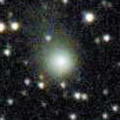
It brightened up to 12.1 mag in 2023 spring (May 20, 2023, Jose Guilherme de S. Aguiar). It stays 18 mag for a while. It stays observable in good condition. Date(TT) R.A. (2000) Decl. Delta r Elong. m1 Best Time(A, h) Dec. 13 6 19.55 -20 33.6 7.879 8.592 133 17.8 0:54 (180, 76) Dec. 20 6 15.82 -20 21.8 7.906 8.639 135 17.8 0:23 (180, 75) |
(468861) 2013 LU28
|
Peculiar asteroid moving along a cometary orbit. It brightened up to 17 mag from 2024 to 2025. Now it is 17.8 mag (Oct. 5, ATLAS-HKO, Haleakala). It stays 18 mag for a while. It stays observable in good condition. Date(TT) R.A. (2000) Decl. Delta r Elong. m1 Best Time(A, h) Dec. 13 6 31.99 22 36.4 8.314 9.262 163 17.9 1:07 (180, 32) Dec. 20 6 27.43 22 21.3 8.301 9.275 171 17.9 0:35 (180, 33) |
C/2023 U1 ( Fuls )

|
It continues brightening even after the perihelion passage. Now it is 17.6 mag (Dec. 12, ATLAS Chile). It stays 18 mag for a while. In the Northern Hemisphere, it will never be observable after this. In the Southern Hemisphere, it will be getting lower gradually. Date(TT) R.A. (2000) Decl. Delta r Elong. m1 Best Time(A, h) Dec. 13 23 15.54 -60 34.4 6.204 5.930 69 17.9 20:54 ( 35, 51) Dec. 20 23 12.98 -59 18.6 6.304 5.958 65 18.0 20:59 ( 38, 47) |
489P/Denning
|
|
It had been lost for 113 years. It passed the perihelion on Dec. 4. It brightened up to 18 mag in outburst in 2007. Brightening slowly. In the Northern Hemisphere, it stays observable in good condition. In the Southern Hemisphere, it will be getting higher gradually. Date(TT) R.A. (2000) Decl. Delta r Elong. m1 Best Time(A, h) Dec. 13 11 48.22 6 6.4 1.286 1.564 86 22.1 2:53 (241, 26) Dec. 20 12 4.25 4 20.8 1.247 1.571 88 22.0 2:55 (240, 30) |