Weekly Information about Bright Comets (2026 Feb. 28: South)
|
Japanese version Home page |
Updated on March 3, 2026 |
|||
|
||||
|
Best time and the azimuth, altitude (A,h) are at lat. 35 deg in the Southern Hemisphere. Azimuth indicates 0 for south, 90 for west, 180 for north, 270 for east. |

|

|
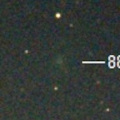
It brightened up to 6.6 mag in January (Jan. 28, Chris Wyatt). Now it is 8.4 mag (Mar. 1, Marco Goiato). Fading rapidly. It will be unobservable in June. Date(TT) R.A. (2000) Decl. Delta r Elong. m1 Best Time(A, h) Feb. 28 2 35.49 -16 38.8 1.080 0.996 57 8.2 20:06 ( 93, 33) Mar. 7 3 12.43 -7 55.4 1.183 1.109 60 8.7 19:55 (105, 32) |
 88P/Howell
|
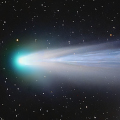
Now it is 10.5 mag (Feb. 24, Martin Masek). Fading slowly. It stays extremely low in the Northern Hemisphere. But it will become high in summer. It locates somewhat low in the Southern Hemisphere. But it will become high in summer. Date(TT) R.A. (2000) Decl. Delta r Elong. m1 Best Time(A, h) Feb. 28 20 23.26 -21 22.1 2.045 1.374 36 10.0 4:17 (285, 17) Mar. 7 20 48.99 -20 1.6 2.020 1.364 36 9.9 4:25 (282, 18) |
C/2025 A6 ( Lemmon )
|
It brightened up to 3.7 mag in late October (Oct. 26, Juan Jose Gonzalez). Now it is 10.5 mag (Feb. 13, Mitsunori Tsumura). It will fade out rapidly after this. In the Northern Hemisphere, it is not observable now, but it will appear in April. In the Southern Hemisphere, it stays observable in good condition. Date(TT) R.A. (2000) Decl. Delta r Elong. m1 Best Time(A, h) Feb. 28 16 6.76 -60 26.0 1.941 2.137 87 10.4 4:17 (339, 61) Mar. 7 15 37.70 -62 46.4 1.916 2.236 95 10.7 4:25 (356, 62) |
24P/Schaumasse

|
It brightened up to 8.4 mag in January (Jan. 14, Mitsunori Tsumura). Now it is 11.1 mag (Feb. 28, Yoshimi Nagai). It will fade out rapidly after this. It will be fainter than 18 mag in June. It stays observable in good condition. Date(TT) R.A. (2000) Decl. Delta r Elong. m1 Best Time(A, h) Feb. 28 15 23.46 6 14.4 0.644 1.357 110 10.7 4:17 (193, 48) Mar. 7 15 27.60 5 50.1 0.650 1.402 115 11.2 4:25 (182, 49) |
C/2025 R3 ( PanSTARRS )
|
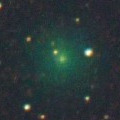
It became brighter than expected. It is expected to brighten up to 5 mag in April. Now it is 10.7 mag (Feb. 28, Mike Olason). Brightening rapidly. In the Northern Hemisphere, it will be unobservable in April. In the Southern Hemisphere, it is not observable now, but it will appear in April. At the high light, it is observable in the low sky before the perihelion passage in the Northern Hemisphere, or after the perihelion in the Southern Hemisphere. Date(TT) R.A. (2000) Decl. Delta r Elong. m1 Best Time(A, h) Feb. 28 22 22.95 17 50.1 2.012 1.208 26 11.8 4:17 (268,-30) Mar. 7 22 25.78 18 9.0 1.891 1.089 25 11.3 4:25 (263,-23) |
240P/NEAT

|
It brightened up to 11.1 mag in winter (Nov. 15, Masayoshi Yoshimi). The component B also brightened rapidly up to 13.8 mag (Ded. 8, Masayoshi Yoshimi). Now it is 13.8 mag (Feb. 12, Toru Yusa). Fading gradually. In the Northern Hemisphere, it stays observable in good condition. In the Southern Hemisphere, it will be unobservable in June. Date(TT) R.A. (2000) Decl. Delta r Elong. m1 Best Time(A, h) Feb. 28 4 5.16 28 47.7 2.029 2.192 85 13.0 20:06 (146, 17) Mar. 7 4 16.44 29 57.4 2.122 2.207 81 13.2 19:55 (145, 15) |
C/2026 A1 ( MAPS )
|
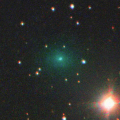
Kreutz sungrazer comet discovered furthest from Sun in history. It will approach to Sun down to 0.005 a.u. on Apr. 4. Now it is 12.5 mag (Feb. 28, Yoshimi Nagai). It is expected to brighten up to 6-7 mag when observable on the ground. In the Northern Hemisphere, it will be unobservable in March. In the Southern Hemisphere, it will be unobservable temporarily in April. Date(TT) R.A. (2000) Decl. Delta r Elong. m1 Best Time(A, h) Feb. 28 2 53.51 -17 41.2 1.272 1.184 61 13.8 20:06 ( 94, 37) Mar. 7 2 39.37 -14 6.7 1.257 1.023 52 13.1 19:55 ( 93, 29) |
235P/LINEAR
|
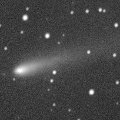
It became brighter than expected. Now it is 13.1 mag (Feb. 19, Ken-ichi Kadota). Fading slowly. It stays observable in good condition. Date(TT) R.A. (2000) Decl. Delta r Elong. m1 Best Time(A, h) Feb. 28 16 31.15 -17 59.9 1.790 2.049 90 13.2 4:17 (240, 61) Mar. 7 16 41.70 -17 40.1 1.730 2.064 94 13.2 4:25 (231, 65) |
C/2026 B2 ( Sun-Gao )
|
Bright new comet discovered near Sun. It became brighter furthermore after the discovery, brightened up to 12.7 mag (Feb. 14, Mike Olason). Now it is 13.2 mag (Feb. 18, Mike Olason). It will fade out rapidly after this. It will be fainter than 18 mag in June. It stays extremely low in the Northern Hemisphere. In the Southern Hemisphere, it will never be observable after this. Date(TT) R.A. (2000) Decl. Delta r Elong. m1 Best Time(A, h) Feb. 28 21 24.74 23 28.6 2.136 1.470 36 13.5 4:17 (255,-20) Mar. 7 21 50.27 26 16.9 2.192 1.522 37 13.7 4:25 (251,-20) |
C/2025 L1 ( ATLAS )

|
Now it is 15.5 mag (Feb. 1, Ken-ichi Kadota). It will turn to fade out rapidly after the peak. In the Northern Hemisphere, it stays observable in good condition. In the Southern Hemisphere, it will be getting lower gradually. It is fainter than this ephemeris recently. Date(TT) R.A. (2000) Decl. Delta r Elong. m1 Best Time(A, h) Feb. 28 15 51.71 -7 46.9 1.306 1.787 101 13.6 4:17 (213, 59) Mar. 7 15 42.88 -0 23.6 1.208 1.820 111 13.5 4:25 (189, 55) |
29P/Schwassmann-Wachmann 1
|
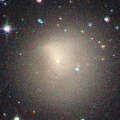
Now it is 11.3 mag (Feb. 28, Yoshimi Nagai). It stays observable in good condition. Date(TT) R.A. (2000) Decl. Delta r Elong. m1 Best Time(A, h) Feb. 28 11 21.08 -3 13.3 5.349 6.311 165 13.6 0:52 (180, 58) Mar. 7 11 18.05 -2 59.7 5.329 6.311 171 13.6 0:22 (180, 58) |
78P/Gehrels 2

|
It will brighten up to 12 mag in summer. Now it is 14.5 mag (Jan. 16, Kunihiro Shima). Brightening slowly. Now it is not observable. It will appear in May in the Southern Hemisphere, or in June in the Northern Hemisphere. Date(TT) R.A. (2000) Decl. Delta r Elong. m1 Best Time(A, h) Feb. 28 23 26.33 -1 2.2 3.172 2.218 13 13.8 20:06 ( 79,-14) Mar. 7 23 40.52 0 18.0 3.166 2.195 9 13.7 19:55 ( 80,-15) |
C/2024 J3 ( ATLAS )

|
Now it is 14.9 mag (Feb. 9, Ken-ichi Kadota). Brightening slowly. It will be getting higher gradually. Date(TT) R.A. (2000) Decl. Delta r Elong. m1 Best Time(A, h) Feb. 28 19 57.42 4 21.1 5.188 4.515 43 14.3 4:17 (259, 8) Mar. 7 20 1.93 5 44.5 5.088 4.485 47 14.3 4:25 (253, 13) |
C/2022 QE78 ( ATLAS )
|
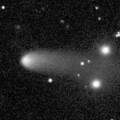
Now it is 14.4 mag (Feb. 15, Ken-ichi Kadota). It stays 15 mag for a while. In the Northern Hemisphere, it stays observable in good condition. It locates somewhat low in the Southern Hemisphere. Date(TT) R.A. (2000) Decl. Delta r Elong. m1 Best Time(A, h) Feb. 28 9 6.36 30 16.3 4.747 5.615 148 14.4 22:34 (180, 25) Mar. 7 9 4.41 30 44.3 4.816 5.626 141 14.4 22:04 (180, 24) |
C/2024 T5 ( ATLAS )
|
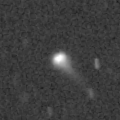
Now it is 14.5 mag (Feb. 3, Ken-ichi Kadota). It stays 14 mag for a while. In the Northern Hemisphere, it will be unobservable soon. In the Southern Hemisphere, it will be getting lower gradually. But it will be getting higher again after June. It is expected to brighten up to 11 mag in next winter. Date(TT) R.A. (2000) Decl. Delta r Elong. m1 Best Time(A, h) Feb. 28 2 50.52 -30 28.4 5.713 5.317 61 14.5 20:06 ( 79, 42) Mar. 7 2 54.84 -29 10.4 5.732 5.278 58 14.4 19:55 ( 79, 39) |
C/2022 N2 ( PanSTARRS )
|
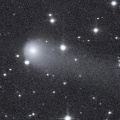
Now it is 14.8 mag (Feb. 20, Toru Yusa). Fading slowly. It will be unobservable in May. Date(TT) R.A. (2000) Decl. Delta r Elong. m1 Best Time(A, h) Feb. 28 3 40.54 24 44.3 4.312 4.246 79 14.5 20:06 (139, 17) Mar. 7 3 46.78 24 54.6 4.438 4.273 74 14.5 19:55 (137, 15) |
C/2025 T1 ( ATLAS )

|
It brightened up to 9.0 mag from late November to early December (Nov. 22, Thomas Lehmann). Fading rapidly. It will be fainter than 18 mag in May. Now it is not observable. It will appear soon in the Southern Hemisphere. In the Northern Hemisphere, it will never be observable after this. Date(TT) R.A. (2000) Decl. Delta r Elong. m1 Best Time(A, h) Feb. 28 21 52.11 -18 4.1 2.689 1.756 15 14.6 4:17 (294, -2) Mar. 7 21 59.12 -19 31.9 2.717 1.835 21 15.1 4:25 (291, 4) |
C/2014 UN271 ( Bernardinelli-Bernstein )

|
Very large comet. It is expected to brighten up to 13 mag in 2031. Now it is 14.6 mag (Jan. 20, Chris Wyatt). It stays 15 mag for a while. In the Northern Hemisphere, it is not observable now. In the Southern Hemisphere, it stays observable in good condition. In the Northern Hemisphere, it is not observable until 2030. Date(TT) R.A. (2000) Decl. Delta r Elong. m1 Best Time(A, h) Feb. 28 4 44.29 -72 15.4 14.316 14.218 82 14.8 20:06 ( 13, 50) Mar. 7 4 45.92 -71 50.8 14.283 14.196 83 14.8 19:55 ( 15, 50) |
C/2021 G2 ( ATLAS )

|
Now it is 15.3 mag (Feb. 1, Ken-ichi Kadota). It stays 15 mag for a while. It stays observable in good condition. Date(TT) R.A. (2000) Decl. Delta r Elong. m1 Best Time(A, h) Feb. 28 17 23.98 4 59.0 6.502 6.414 80 14.8 4:17 (231, 36) Mar. 7 17 26.34 5 45.8 6.435 6.446 86 14.8 4:25 (222, 40) |
C/2023 R1 ( PanSTARRS )

|
Now it is 15.3 mag (Dec. 19, Kunihiro Shima). It stays 15 mag for a while. It will be getting higher gradually. Date(TT) R.A. (2000) Decl. Delta r Elong. m1 Best Time(A, h) Feb. 28 19 35.01 -3 26.7 4.197 3.593 46 15.0 4:17 (262, 17) Mar. 7 19 35.10 -3 28.7 4.091 3.586 53 14.9 4:25 (257, 24) |
C/2025 Q3 ( ATLAS )

|
It became brighter than expected. Now it is 15.2 mag (Feb. 12, Ken-ichi Kadota). Fading gradually. In the Northern Hemisphere, it will be unobservable soon. It locates somewhat low in the Southern Hemisphere. Date(TT) R.A. (2000) Decl. Delta r Elong. m1 Best Time(A, h) Feb. 28 2 25.49 -19 53.7 2.517 2.113 55 15.1 20:06 ( 88, 33) Mar. 7 2 32.46 -20 48.3 2.583 2.115 51 15.2 19:55 ( 85, 31) |
40P/Vaisala 1
|
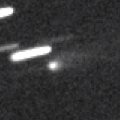
It became brighter than expected, brightened up to 14.3 mag (Jan. 21, Michael Jager). Now it is 16.1 mag (Feb. 9, Yoshimi Nagai). Fading slowly. It stays observable in good condition. Date(TT) R.A. (2000) Decl. Delta r Elong. m1 Best Time(A, h) Feb. 28 17 16.48 -11 14.9 2.045 2.114 80 15.4 4:17 (244, 49) Mar. 7 17 26.70 -11 6.0 2.002 2.148 84 15.5 4:25 (237, 53) |
3I/2025 N1 ( ATLAS )

|
Third interstellar object in history following 1I/'Oumuamua and 2I/Borisov. The eccentricity is extremely big as 6. It approached to Sun down to 1.38 a.u. in late October. It brightened up to 8.9 mag in November (Nov. 12, Toshiyuki Takahashi). Now it is 15.4 mag (Feb. 20, Mitsunori Tsumura). Fading rapidly. It will be fainter than 18 mag in April. In the Northern Hemisphere, it stays observable in good condition. Date(TT) R.A. (2000) Decl. Delta r Elong. m1 Best Time(A, h) Feb. 28 7 2.29 20 1.9 3.900 4.548 125 15.5 20:30 (180, 35) Mar. 7 6 56.27 20 11.0 4.247 4.782 117 15.9 19:56 (180, 35) |
218P/LINEAR

|
Now it is 16.8 mag (Dec. 30, Hidenori Nohara). Fading gradually. It will be fainter than 18 mag in June. It stays extremely low in the Northern Hemisphere. But it will become high in summer. In the Southern Hemisphere, it stays observable in good condition. Date(TT) R.A. (2000) Decl. Delta r Elong. m1 Best Time(A, h) Feb. 28 18 43.66 -21 0.2 1.260 1.131 58 15.9 4:17 (271, 37) Mar. 7 19 14.65 -20 7.2 1.265 1.130 58 15.8 4:25 (270, 37) |
C/2022 R6 ( PanSTARRS )
|
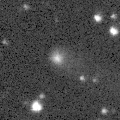
Now it is 16.0 mag (Jan. 25, Ken-ichi Kadota). It stays 16 mag for a while. It stays observable in good condition. Date(TT) R.A. (2000) Decl. Delta r Elong. m1 Best Time(A, h) Feb. 28 8 34.01 -5 50.1 5.847 6.683 145 16.1 22:01 (180, 61) Mar. 7 8 32.33 -4 57.0 5.905 6.692 139 16.1 21:32 (180, 60) |
C/2025 J1 ( Borisov )
|
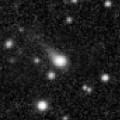
Now it is 16.4 mag (Feb. 9, Ken-ichi Kadota). It stays 17 mag for a while. In the Northern Hemisphere, it will be getting lower gradually after this, and it will be unobservable in June. In the Southern Hemisphere, it is not observable now. Date(TT) R.A. (2000) Decl. Delta r Elong. m1 Best Time(A, h) Feb. 28 4 50.11 59 58.3 3.431 3.702 98 16.4 20:06 (167, -7) Mar. 7 4 51.32 57 22.3 3.511 3.686 92 16.4 19:55 (164, -6) |
145P/Shoemaker-Levy 5

|
Now it is 16.4 mag (Feb. 15, Ken-ichi Kadota). Fading slowly. It will be fainter than 18 mag in June. It will be unobservable soon in the Southern Hemisphere, or in May in the Northern Hemisphere. Date(TT) R.A. (2000) Decl. Delta r Elong. m1 Best Time(A, h) Feb. 28 1 34.24 13 32.7 2.424 1.906 47 16.5 20:06 (109, 3) Mar. 7 1 50.20 15 26.4 2.482 1.916 45 16.5 19:55 (111, 2) |
C/2024 G6 ( ATLAS )

|
Now it is 17.2 mag (Feb. 9, Ken-ichi Kadota). It stays 17 mag for a while. It stays observable in good condition. Date(TT) R.A. (2000) Decl. Delta r Elong. m1 Best Time(A, h) Feb. 28 16 36.83 -0 55.9 6.331 6.430 91 16.7 4:17 (223, 47) Mar. 7 16 35.89 0 3.1 6.214 6.430 98 16.6 4:25 (210, 51) |
195P/Hill

|
Now it is 17.4 mag (Jan. 11, ATLAS South Africa). It stays 17 mag for a while. In the Northern Hemisphere, it will be unobservable in June. In the Southern Hemisphere, it stays observable in good condition. Date(TT) R.A. (2000) Decl. Delta r Elong. m1 Best Time(A, h) Feb. 28 9 29.98 -33 33.3 3.785 4.538 134 16.6 22:57 (180, 89) Mar. 7 9 26.55 -33 3.1 3.794 4.544 134 16.7 22:26 (180, 88) |
123P/West-Hartley
|
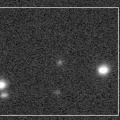
It will brighten up to 15 mag from autumn to winter. Now it is 17.4 mag (Feb. 13, Ken-ichi Kadota). Brightening slowly. In the Northern Hemisphere, it will be getting lower gradually. In the Southern Hemisphere, it will be unobservable in May. Date(TT) R.A. (2000) Decl. Delta r Elong. m1 Best Time(A, h) Feb. 28 3 43.28 29 18.8 2.611 2.649 81 16.7 20:06 (142, 14) Mar. 7 3 51.43 29 45.4 2.675 2.622 76 16.7 19:55 (141, 12) |
493P/2024 Q2 ( LONEOS )
|
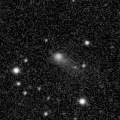
Now it is 16.6 mag (Jan. 10, Hirohisa Sato). It stays 17 mag for a while. In the Northern Hemisphere, it stays observable in good condition. In the Southern Hemisphere, it will be unobservable in April. Date(TT) R.A. (2000) Decl. Delta r Elong. m1 Best Time(A, h) Feb. 28 4 39.08 48 6.7 3.608 3.832 95 16.7 20:06 (161, 3) Mar. 7 4 45.57 47 35.1 3.702 3.836 90 16.7 19:55 (159, 3) |
10P/Tempel 2
|
It is expected to brighten up to 8 mag in summer. Now it is 18.5 mag (Jan. 20, Kunihiro Shima). It will brighten rapidly after this. It stays observable in good condition. Date(TT) R.A. (2000) Decl. Delta r Elong. m1 Best Time(A, h) Feb. 28 17 10.92 -11 6.0 1.976 2.076 81 17.2 4:17 (243, 50) Mar. 7 17 24.56 -11 5.1 1.861 2.033 85 16.7 4:25 (237, 53) |
C/2024 A1 ( ATLAS )
|
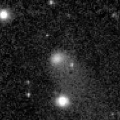
Now it is 16.0 mag (Jan. 22, Kunihiro Shima). Fading slowly. It will be fainter than 18 mag in June. In the Northern Hemisphere, it stays observable in good condition. In the Southern Hemisphere, it will never be observable after this. Date(TT) R.A. (2000) Decl. Delta r Elong. m1 Best Time(A, h) Feb. 28 6 31.38 63 54.8 4.054 4.476 109 16.8 20:06 (179, -9) Mar. 7 6 24.00 63 55.6 4.176 4.506 103 16.9 19:55 (177, -9) |
C/2023 F3 ( ATLAS )

|
Now it is 16.9 mag (Feb. 3, Ken-ichi Kadota). It stays 17 mag for a while. In the Northern Hemisphere, it will be getting lower gradually after this, and it will be unobservable in June. In the Southern Hemisphere, it stays observable in good condition. Date(TT) R.A. (2000) Decl. Delta r Elong. m1 Best Time(A, h) Feb. 28 9 44.78 -19 52.9 5.086 5.954 148 16.8 23:11 (180, 75) Mar. 7 9 37.51 -18 44.8 5.123 5.979 146 16.8 22:37 (180, 74) |
43P/Wolf-Harrington

|
Now it is 16.5 mag (Feb. 21, Toru Yusa). Fading gradually. It will be fainter than 18 mag in May. It stays observable in good condition. Date(TT) R.A. (2000) Decl. Delta r Elong. m1 Best Time(A, h) Feb. 28 10 58.33 -8 29.2 1.883 2.845 162 16.8 0:29 (180, 64) Mar. 7 10 53.64 -7 55.4 1.896 2.869 166 16.9 23:53 (180, 63) |
164P/Christensen
|
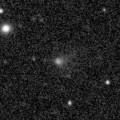
Now it is 16.9 mag (Feb. 21, Ken-ichi Kadota). Fading gradually. It will be fainter than 18 mag in April. In the Northern Hemisphere, it stays observable in good condition. It locates somewhat low in the Southern Hemisphere. Date(TT) R.A. (2000) Decl. Delta r Elong. m1 Best Time(A, h) Feb. 28 10 57.40 31 9.7 1.968 2.904 156 16.8 0:29 (180, 24) Mar. 7 10 50.82 31 40.1 2.023 2.944 153 17.0 23:50 (180, 23) |
63P/Wild 1

|
Now it is 17.5 mag (Feb. 3, Ken-ichi Kadota). Brightening gradually. In the Northern Hemisphere, it stays observable in good condition. It stays extremely low in the Southern Hemisphere. Date(TT) R.A. (2000) Decl. Delta r Elong. m1 Best Time(A, h) Feb. 28 6 7.40 46 25.7 1.790 2.330 110 17.1 20:06 (175, 8) Mar. 7 6 12.80 45 5.4 1.827 2.296 105 16.9 19:55 (173, 9) |
C/2023 X2 ( Lemmon )
|
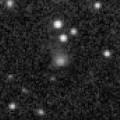
Now it is 17.4 mag (Jan. 15, Ken-ichi Kadota). It stays 17 mag for a while. In the Northern Hemisphere, it stays observable in good condition. In the Southern Hemisphere, it will never be observable after this. Date(TT) R.A. (2000) Decl. Delta r Elong. m1 Best Time(A, h) Feb. 28 21 10.80 81 30.2 5.007 5.110 90 17.0 4:17 (190,-35) Mar. 7 21 20.78 81 49.7 5.049 5.115 88 17.0 4:25 (190,-34) |
C/2025 R2 ( SWAN )
|
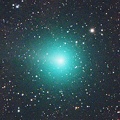
It brightened up to 5.2 mag in October (Oct. 11, Virgilio Gonano). Now it is 16.4 mag (Jan. 20, Kunihiro Shima). Fading gradually. It will be fainter than 18 mag soon. In the Northern Hemisphere, it will be getting lower gradually. It stays extremely low in the Southern Hemisphere. Date(TT) R.A. (2000) Decl. Delta r Elong. m1 Best Time(A, h) Feb. 28 2 17.01 17 49.7 3.301 2.917 58 17.0 20:06 (119, 9) Mar. 7 2 25.83 18 28.2 3.477 3.006 54 17.3 19:55 (118, 7) |
C/2023 RS61 ( PanSTARRS )
|
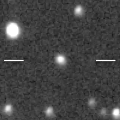
It is around 20 mag usually. However, it brightened in outburst in 2025 autumn up to 17.0 mag (Sept. 4, Taras Prystavski). Now it is 18.1 mag (Feb. 9, Ken-ichi Kadota). It stays 17 mag for a while. It will be unobservable soon in the Southern Hemisphere, or in May in the Northern Hemisphere. But it will be observable again in June in the Northern Hemisphere. Date(TT) R.A. (2000) Decl. Delta r Elong. m1 Best Time(A, h) Feb. 28 2 51.03 35 38.6 8.940 8.701 72 17.1 20:06 (137, 2) Mar. 7 2 53.87 35 38.0 9.034 8.692 66 17.1 19:55 (135, 0) |
210P/Christensen
|
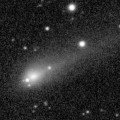
It brightened up to 9.5 mag in late November (Nov. 28, Michael Jager, Gerald Rhemann, E. Prosperi). Now it is 17.2 mag (Feb. 19, Toru Yusa). It will fade out rapidly after this. It will be fainter than 18 mag soon. It stays observable in good condition. Date(TT) R.A. (2000) Decl. Delta r Elong. m1 Best Time(A, h) Feb. 28 15 50.65 -5 59.9 1.235 1.735 101 17.1 4:17 (211, 58) Mar. 7 15 47.01 -5 11.8 1.228 1.820 109 17.3 4:25 (192, 60) |
C/2023 H5 ( Lemmon )

|
Now it is 16.7 mag (Feb. 12, Ken-ichi Kadota). It stays 17 mag for a while. In the Northern Hemisphere, it stays observable in good condition. In the Southern Hemisphere, it will never be observable after this. Date(TT) R.A. (2000) Decl. Delta r Elong. m1 Best Time(A, h) Feb. 28 20 46.13 61 16.1 4.944 4.751 73 17.2 4:17 (214,-30) Mar. 7 20 58.90 61 21.2 4.998 4.775 71 17.2 4:25 (212,-28) |
(248590) 2006 CS
|
|
It seems to be a parent of the beta-Tucanids meteor shower. Fading gradually. It will be fainter than 18 mag in May. In the Northern Hemisphere, it is not observable now, but it will be observable soon. In the Southern Hemisphere, it will be unobservable soon. Date(TT) R.A. (2000) Decl. Delta r Elong. m1 Best Time(A, h) Feb. 28 2 46.73 -50 38.8 0.427 0.902 65 17.4 20:06 ( 51, 46) Mar. 7 2 52.88 -41 43.2 0.310 0.887 61 17.2 19:55 ( 64, 43) |
C/2024 G2 ( ATLAS )

|
Now it is 17.7 mag (Feb. 21, Ken-ichi Kadota). It stays 18 mag for a while. It stays observable in good condition. Date(TT) R.A. (2000) Decl. Delta r Elong. m1 Best Time(A, h) Feb. 28 11 40.26 -1 27.3 4.727 5.680 162 17.4 1:11 (180, 57) Mar. 7 11 34.43 -0 4.3 4.714 5.697 171 17.4 0:38 (180, 55) |
C/2024 G4 ( PanSTARRS )

|
Now it is 17.4 mag (Nov. 1, Alfons Diepvens). It stays 17 mag for a while. It will be getting higher gradually. Date(TT) R.A. (2000) Decl. Delta r Elong. m1 Best Time(A, h) Feb. 28 19 33.83 0 51.8 5.512 4.903 47 17.6 4:17 (258, 14) Mar. 7 19 40.17 1 8.4 5.442 4.902 52 17.6 4:25 (254, 20) |
C/2020 V2 ( ZTF )
|
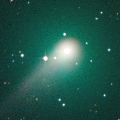
It was observed at 9-10 mag for a long time in 2023. It stays 18 mag for a while. In the Northern Hemisphere, it will never be observable after this. In the Southern Hemisphere, it stays observable in good condition. Date(TT) R.A. (2000) Decl. Delta r Elong. m1 Best Time(A, h) Feb. 28 20 9.75 -65 23.7 9.880 9.472 63 17.8 4:17 (330, 35) Mar. 7 20 13.09 -65 40.9 9.856 9.520 67 17.8 4:25 (330, 38) |
P/2023 S1 ( PanSTARRS )

|
It brightened up to 13.7 mag in last winter (Jan. 4, 2025, W. Pei). It stays 18 mag for a while. It locates somewhat low in the Northern Hemisphere. In the Southern Hemisphere, it stays observable in good condition. Date(TT) R.A. (2000) Decl. Delta r Elong. m1 Best Time(A, h) Feb. 28 15 30.46 -29 27.5 2.982 3.321 101 17.8 4:17 (242, 79) Mar. 7 15 32.59 -29 56.8 2.905 3.342 107 17.8 4:25 (204, 85) |
124P/Mrkos
|
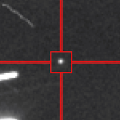
Now it is 18.4 mag (Jan. 16, Kunihiro Shima). It stays 18 mag for a while. In the Northern Hemisphere, it stays observable in good condition. In the Southern Hemisphere, it is not observable now, but it will be observable soon. Date(TT) R.A. (2000) Decl. Delta r Elong. m1 Best Time(A, h) Feb. 28 8 15.77 58 48.1 1.304 2.014 122 17.9 21:43 (180, -4) Mar. 7 8 9.78 56 11.3 1.312 1.985 118 17.9 21:10 (180, -1) |
407P/PanSTARRS-Fuls
|
|
It has not been observed yet in this apparition. It stays 18 mag for a while. In the Northern Hemisphere, it stays observable in good condition. It locates somewhat low in the Southern Hemisphere. Date(TT) R.A. (2000) Decl. Delta r Elong. m1 Best Time(A, h) Feb. 28 7 3.66 27 25.5 1.704 2.412 124 17.9 20:32 (180, 28) Mar. 7 7 4.98 27 22.8 1.758 2.393 118 17.9 20:06 (180, 28) |
C/2017 K2 ( PanSTARRS )
|
It brightened up to 8 mag from 2022 summer to 2023 spring. Now it is 17.5 mag (Feb. 12, Ken-ichi Kadota). It stays 18 mag for a while. In the Northern Hemisphere, it will be getting lower gradually. It locates somewhat low in the Southern Hemisphere. Date(TT) R.A. (2000) Decl. Delta r Elong. m1 Best Time(A, h) Feb. 28 5 29.26 31 12.0 10.405 10.690 104 17.9 20:06 (164, 22) Mar. 7 5 28.76 31 13.2 10.570 10.738 97 18.0 19:55 (160, 21) |
489P/Denning
|
|
It had been lost for 113 years. It must have passed the perihelion on Dec. 4. It brightened up to 18 mag in outburst in 2007. Fading gradually. It stays observable in good condition. Date(TT) R.A. (2000) Decl. Delta r Elong. m1 Best Time(A, h) Feb. 28 13 25.65 -6 8.6 0.964 1.818 136 21.3 2:56 (180, 61) Mar. 7 13 23.51 -6 18.4 0.958 1.856 144 21.2 2:27 (180, 61) |