Weekly Information about Bright Comets (2026 June 6: North)
|
Japanese version Home page |
Updated on June 8, 2026 |
|||
|
||||
|
Best time and the azimuth, altitude (A,h) are at lat. 35 deg in the Northern Hemisphere. Azimuth indicates 0 for south, 90 for west, 180 for north, 270 for east. |

|
|
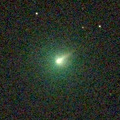
Major outburst of about 9 mag occured from May 31 to June 1. Now it is 8.3 mag (June 3, Marco Goiato). Probably, it will fade out rapidly after this. In the Northern Hemisphere, it will be getting higher gradually. In the Southern Hemisphere, it stays observable in good condition. Date(TT) R.A. (2000) Decl. Delta r Elong. m1 Best Time(A, h) June 6 0 12.42 2 2.0 1.555 1.561 71 8.4 3:01 (284, 23) June 13 0 31.24 3 23.5 1.514 1.559 73 8.6 2:58 (284, 25) |
 C/2025 R3 ( PanSTARRS )
|
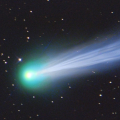
It brightened up to 4.0 mag in late April (Apr. 30, Chris Wyatt). It brightened up to 1.3 mag due to the forward scattering in the SOHO LASCO images (Apr. 25, Mikolaj Kaszczyk). Now it is 8.8 mag (May 31, Marco Goiato). Fading rapidly. In the Northern Hemisphere, it is not observable now, but it will appear in September. It locates somewhat low in the Southern Hemisphere. But it will become high in autumn. Date(TT) R.A. (2000) Decl. Delta r Elong. m1 Best Time(A, h) June 6 6 42.16 -10 46.1 1.664 1.143 42 9.5 20:56 ( 91,-21) June 13 6 50.51 -11 5.5 1.852 1.262 40 10.2 21:01 ( 95,-26) |
10P/Tempel 2
|
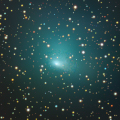
It is expected to brighten up to 8 mag in summer. Now it is 12.9 mag (May 29, Mitsunori Tsumura). Brightening gradually. It stays observable in good condition. Date(TT) R.A. (2000) Decl. Delta r Elong. m1 Best Time(A, h) June 6 20 19.62 -8 25.6 0.683 1.538 128 10.3 3:01 (352, 46) June 13 20 32.31 -8 58.9 0.626 1.512 132 9.9 2:58 (356, 46) |
88P/Howell
|
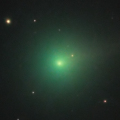
Now it is 11.1 mag (May 29, Toru Yusa). Fading gradually. In the Northern Hemisphere, it will be getting higher gradually. In the Southern Hemisphere, it stays observable in good condition. Date(TT) R.A. (2000) Decl. Delta r Elong. m1 Best Time(A, h) June 6 1 15.97 4 22.1 1.936 1.604 55 10.7 3:01 (272, 11) June 13 1 31.06 5 52.4 1.927 1.643 58 10.9 2:58 (272, 14) |
78P/Gehrels 2

|
It stays 12 mag for a while. In the Northern Hemisphere, it is not observable now, but it will be observable soon. It stays extremely low in the Southern Hemisphere. But it will become high in autumn. Date(TT) R.A. (2000) Decl. Delta r Elong. m1 Best Time(A, h) June 6 3 3.89 16 55.9 2.866 2.011 26 12.5 3:01 (247, -3) June 13 3 20.83 17 48.5 2.831 2.007 29 12.4 2:58 (247, -1) |
C/2023 R1 ( PanSTARRS )

|
Now it is 12.9 mag (May 31, Toru Yusa). Fading slowly. It stays observable in good condition. Date(TT) R.A. (2000) Decl. Delta r Elong. m1 Best Time(A, h) June 6 17 51.76 -6 28.6 2.638 3.603 158 13.3 0:57 ( 0, 49) June 13 17 34.43 -7 10.0 2.626 3.612 163 13.3 0:12 ( 0, 48) |
141P/Machholz 2

|
The condition is very bad in this apparition. It is not observable at all. It will fade out rapidly after this. It will be fainter than 18 mag in July. It will never be observable after this. Date(TT) R.A. (2000) Decl. Delta r Elong. m1 Best Time(A, h) June 6 5 48.59 18 54.9 2.028 1.065 13 13.6 20:56 (124,-12) June 13 6 18.31 18 4.1 2.095 1.134 13 14.2 21:01 (124,-13) |
C/2024 T5 ( ATLAS )
|
Now it is 13.9 mag (Mar. 12, ATLAS South Africa). Brightening slowly. In the Northern Hemisphere, it is not observable now, but it will appear in August. In the Southern Hemisphere, it will be getting higher gradually. It is expected to brighten up to 11 mag in next winter. Date(TT) R.A. (2000) Decl. Delta r Elong. m1 Best Time(A, h) June 6 4 15.83 -16 8.8 5.532 4.798 39 13.7 3:01 (264,-37) June 13 4 22.85 -15 32.5 5.477 4.763 41 13.7 2:58 (266,-33) |
C/2024 J3 ( ATLAS )

|
Now it is 14.1 mag (May 29, Toru Yusa). It stays 14 mag for a while. In the Northern Hemisphere, it stays observable in good condition. It locates somewhat low in the Southern Hemisphere. Date(TT) R.A. (2000) Decl. Delta r Elong. m1 Best Time(A, h) June 6 20 14.44 30 28.9 3.711 4.146 108 13.8 3:01 (319, 84) June 13 20 9.63 32 33.1 3.641 4.125 111 13.7 2:46 ( 0, 88) |
29P/Schwassmann-Wachmann 1
|
Now it is 12.2 mag (May 30, Toru Yusa). It will be getting lower gradually after this, and it will be unobservable in August in the Northern Hemisphere, or in September in the Southern Hemisphere. Date(TT) R.A. (2000) Decl. Delta r Elong. m1 Best Time(A, h) June 6 11 1.51 -0 56.3 6.200 6.316 91 14.0 20:56 ( 58, 36) June 13 11 3.22 -1 2.8 6.310 6.316 85 14.0 21:01 ( 64, 30) |
C/2014 UN271 ( Bernardinelli-Bernstein )

|
Very large comet. It is expected to brighten up to 13 mag in 2031. Now it is 14.9 mag (May 19, Andrew Pearce). It stays 15 mag for a while. In the Northern Hemisphere, it is not observable now. In the Southern Hemisphere, it stays observable in good condition. In the Northern Hemisphere, it is not observable until 2030. Date(TT) R.A. (2000) Decl. Delta r Elong. m1 Best Time(A, h) June 6 5 51.32 -68 5.3 13.859 13.918 91 14.6 20:56 ( 26,-44) June 13 5 58.23 -68 1.3 13.835 13.897 91 14.6 21:01 ( 25,-46) |
235P/LINEAR
|
It became brighter than expected. Now it is 14.2 mag (May 17, Ken-ichi Kadota). It will fade out rapidly after this. It will be fainter than 18 mag in August. It stays observable in good condition. Date(TT) R.A. (2000) Decl. Delta r Elong. m1 Best Time(A, h) June 6 16 53.85 -8 35.3 1.353 2.350 165 14.6 23:54 ( 0, 46) June 13 16 48.59 -8 16.3 1.388 2.377 162 14.9 23:21 ( 0, 47) |
63P/Wild 1
|
Now it is 14.8 mag (May 31, Toru Yusa). It stays 15 mag for a while. It will be unobservable in August in the Northern Hemisphere, or in September in the Southern Hemisphere. Date(TT) R.A. (2000) Decl. Delta r Elong. m1 Best Time(A, h) June 6 8 55.31 24 23.8 2.403 1.997 54 14.9 20:56 (103, 26) June 13 9 10.25 22 23.2 2.447 1.988 51 14.8 21:01 (103, 21) |
P/2021 N1 ( ZTF )
|
|
First return of a new periodic comet which brightened up to 17 mag in 2021. It will approach to Earth down to 0.17 a.u. from June to July. It is expected to brighten up to 14 mag. It brightens up to 14 mag, but it will turn to fade out rapidly after that. In the Northern Hemisphere, it will be getting higher gradually. In the Southern Hemisphere, it will be getting lower gradually. But it will be getting higher again after June. Date(TT) R.A. (2000) Decl. Delta r Elong. m1 Best Time(A, h) June 6 20 47.13 -51 1.6 0.285 1.209 127 15.6 3:01 (352, 3) June 13 21 53.16 -47 4.3 0.232 1.155 121 15.0 2:58 (345, 5) |
260P/McNaught
|
|
It will brighten up to 13 mag and will be observable in good condition from summer to autumn. Now it is 15.9 mag (May 28, Ken-ichi Kadota). Brightening gradually. In the Northern Hemisphere, it will be getting higher gradually. In the Southern Hemisphere, it stays observable in good condition. Date(TT) R.A. (2000) Decl. Delta r Elong. m1 Best Time(A, h) June 6 0 26.62 -3 23.5 1.584 1.567 70 15.4 3:01 (286, 16) June 13 0 45.03 -0 24.0 1.518 1.536 71 15.0 2:58 (285, 20) |
C/2022 QE78 ( ATLAS )
|
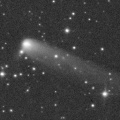
Now it is 15.2 mag (May 18, Toru Yusa). It stays 15 mag for a while. It will be unobservable in July in the Southern Hemisphere, or in August in the Northern Hemisphere. But it will be observable again in September in the Northern Hemisphere. Date(TT) R.A. (2000) Decl. Delta r Elong. m1 Best Time(A, h) June 6 9 28.25 31 9.2 6.243 5.814 60 15.1 20:56 (106, 35) June 13 9 33.33 30 54.4 6.347 5.831 55 15.2 21:01 (109, 30) |
C/2021 G2 ( ATLAS )

|
Now it is 15.3 mag (May 25, Ken-ichi Kadota). It stays 16 mag for a while. It stays observable in good condition. Date(TT) R.A. (2000) Decl. Delta r Elong. m1 Best Time(A, h) June 6 17 15.61 15 14.3 6.050 6.876 141 15.3 0:20 ( 0, 70) June 13 17 12.80 15 34.4 6.090 6.910 141 15.3 23:46 ( 0, 71) |
C/2024 R4 ( PanSTARRS )
|
Now it is 15.4 mag (May 27, ATLAS-MLO, Mauna Loa). It stays 15 mag for a while. In the Northern Hemisphere, it stays observable in good condition. It stays extremely low in the Southern Hemisphere. Date(TT) R.A. (2000) Decl. Delta r Elong. m1 Best Time(A, h) June 6 22 10.79 39 57.1 6.008 5.981 83 15.4 3:01 (249, 63) June 13 22 7.89 41 16.0 5.893 5.945 87 15.3 2:58 (245, 68) |
24P/Schaumasse

|
It brightened up to 8.4 mag in January (Jan. 14, Mitsunori Tsumura). Now it is 14.3 mag (May 31, Toru Yusa). Fading rapidly. It will be fainter than 18 mag in July. It stays observable in good condition. Date(TT) R.A. (2000) Decl. Delta r Elong. m1 Best Time(A, h) June 6 14 15.84 -4 22.2 1.280 2.141 137 15.4 21:17 ( 0, 50) June 13 14 15.81 -5 30.7 1.392 2.200 131 15.9 21:01 ( 4, 49) |
C/2022 N2 ( PanSTARRS )
|
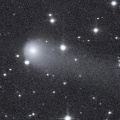
Now it is 15.8 mag (May 7, Ken-ichi Kadota). It stays 16 mag for a while. Now it is not observable. It will appear in July in the Northern Hemisphere, or in August in the Southern Hemisphere. Date(TT) R.A. (2000) Decl. Delta r Elong. m1 Best Time(A, h) June 6 5 31.34 26 57.7 5.665 4.667 9 15.5 20:56 (133, -9) June 13 5 39.91 26 59.9 5.711 4.701 5 15.5 21:01 (137,-13) |
123P/West-Hartley

|
It will brighten up to 15 mag from autumn to winter. Now it is 17.6 mag (May 17, Kunihiro Shima). It stays 15 mag for a while. In the Northern Hemisphere, it will be unobservable soon. But it will be observable again in September. In the Southern Hemisphere, it is not observable now. Date(TT) R.A. (2000) Decl. Delta r Elong. m1 Best Time(A, h) June 6 6 45.33 33 6.8 3.176 2.313 26 15.8 20:56 (126, 6) June 13 7 2.06 32 50.4 3.188 2.295 23 15.7 21:01 (128, 4) |
93P/Lovas 1
|
Now it is 16.0 mag (Jan. 18, Kunihiro Shima). Fading slowly. Now it is not observable. It will appear in August in the Northern Hemisphere, or in October in the Southern Hemisphere. Date(TT) R.A. (2000) Decl. Delta r Elong. m1 Best Time(A, h) June 6 4 47.57 30 7.6 2.725 1.725 7 15.7 3:01 (220,-11) June 13 5 10.10 30 37.0 2.741 1.741 8 15.8 2:58 (221,-10) |
C/2025 Y1 ( ATLAS )
|
Now it is 16.3 mag (May 24, ATLAS-MLO, Mauna Loa). It stays 16 mag for a while. It will be getting lower gradually after this, and it will be unobservable in September. Date(TT) R.A. (2000) Decl. Delta r Elong. m1 Best Time(A, h) June 6 12 39.79 4 41.7 5.005 5.467 112 16.4 20:56 ( 34, 55) June 13 12 39.71 4 39.7 5.055 5.415 105 16.4 21:01 ( 45, 51) |
C/2024 G6 ( ATLAS )

|
Now it is 16.6 mag (May 26, ATLAS-HKO, Haleakala). It stays 17 mag for a while. It stays observable in good condition. Date(TT) R.A. (2000) Decl. Delta r Elong. m1 Best Time(A, h) June 6 15 39.02 13 19.8 5.664 6.470 139 16.5 22:39 ( 0, 68) June 13 15 33.58 13 55.5 5.727 6.475 134 16.5 22:06 ( 0, 69) |
C/2025 A6 ( Lemmon )
|
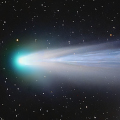
It brightened up to 3.7 mag in late October (Oct. 26, Juan Jose Gonzalez). Now it is 16.4 mag (May 25, ATLAS Chile). It will fade out rapidly after this. It will be fainter than 18 mag in July. In the Northern Hemisphere, it will be unobservable soon. In the Southern Hemisphere, it stays observable in good condition. Date(TT) R.A. (2000) Decl. Delta r Elong. m1 Best Time(A, h) June 6 10 46.84 -37 51.2 3.055 3.416 102 16.6 20:56 ( 35, 5) June 13 10 47.86 -36 10.0 3.233 3.500 96 16.9 21:01 ( 41, 2) |
C/2022 R6 ( PanSTARRS )
|
Now it is 16.5 mag (May 22, ATLAS Chile). It stays 17 mag for a while. It will be unobservable soon in the Northern Hemisphere, or in August in the Southern Hemisphere. But it will be observable again in September. Date(TT) R.A. (2000) Decl. Delta r Elong. m1 Best Time(A, h) June 6 8 49.39 3 49.3 7.291 6.835 59 16.7 20:56 ( 85, 13) June 13 8 53.18 4 9.0 7.396 6.848 53 16.7 21:01 ( 90, 8) |
65P/Gunn
|
Now it is 18.0 mag (May 24, Andrew Pearce). It stays 17 mag for a while. In the Northern Hemisphere, it will be getting higher gradually. In the Southern Hemisphere, it stays observable in good condition. Date(TT) R.A. (2000) Decl. Delta r Elong. m1 Best Time(A, h) June 6 0 25.04 -6 30.6 3.545 3.373 72 17.0 3:01 (289, 15) June 13 0 30.97 -6 4.2 3.466 3.388 77 17.0 2:58 (292, 19) |
169P/NEAT
|
It will approach to Earth down to 0.17 a.u. in August. It is expected to brighten up to 10 mag from August to September. Now it is 17.7 mag (May 23, W. Hasubick). It will brighten rapidly after this. It will be getting lower gradually after this, and it will be unobservable in August. But it will be observable again in in the Northern Hemisphere, or in September in the Southern Hemisphere. Date(TT) R.A. (2000) Decl. Delta r Elong. m1 Best Time(A, h) June 6 19 36.73 1 6.8 0.898 1.761 133 17.4 2:41 ( 0, 56) June 13 19 35.86 3 13.4 0.784 1.684 138 17.0 2:13 ( 0, 58) |
C/2025 M2 ( PanSTARRS )
|
It is expected to brighten up to 12 mag from 2027 to 2028. Now it is 17.1 mag (May 23, ATLAS-MLO, Mauna Loa). It stays 17 mag for a while. It stays observable in good condition. Date(TT) R.A. (2000) Decl. Delta r Elong. m1 Best Time(A, h) June 6 20 50.47 -17 12.2 5.130 5.767 124 17.2 3:01 (344, 36) June 13 20 45.15 -17 28.5 4.979 5.716 132 17.1 2:58 (353, 37) |
C/2024 G4 ( PanSTARRS )

|
Now it is 17.6 mag (May 25, Alfons Diepvens). It stays 17 mag for a while. It stays observable in good condition. Date(TT) R.A. (2000) Decl. Delta r Elong. m1 Best Time(A, h) June 6 20 22.76 4 17.2 4.316 4.936 122 17.1 3:01 (347, 59) June 13 20 22.27 4 12.6 4.246 4.943 128 17.1 2:58 ( 0, 59) |
C/2026 A2 ( Bok )
|
It will brighten up to 14 mag from autumn to winter. Now it is 17.1 mag (May 22, ATLAS-MLO, Mauna Loa). Brightening gradually. In the Northern Hemisphere, it stays observable in good condition. In the Southern Hemisphere, it is not observable now. Date(TT) R.A. (2000) Decl. Delta r Elong. m1 Best Time(A, h) June 6 18 16.12 74 38.7 3.014 3.041 81 17.2 1:19 (180, 50) June 13 18 4.44 76 7.3 2.977 2.983 80 17.1 0:40 (180, 49) |
C/2025 E1 ( PanSTARRS )
|
Now it is 17.3 mag (May 16, ATLAS South Africa). It stays 17 mag for a while. In the Northern Hemisphere, it will never be observable after this. In the Southern Hemisphere, it stays observable in good condition. Date(TT) R.A. (2000) Decl. Delta r Elong. m1 Best Time(A, h) June 6 8 34.87 -63 6.8 3.877 4.107 95 17.1 20:56 ( 30,-27) June 13 8 38.24 -62 49.6 3.893 4.094 94 17.1 21:01 ( 32,-30) |
C/2023 X2 ( Lemmon )
|
Now it is 17.0 mag (May 17, Kunihiro Shima). It stays 18 mag for a while. In the Northern Hemisphere, it stays observable in good condition. In the Southern Hemisphere, it will never be observable after this. Date(TT) R.A. (2000) Decl. Delta r Elong. m1 Best Time(A, h) June 6 13 19.51 83 29.3 5.467 5.231 71 17.3 20:56 (179, 42) June 13 13 16.64 81 53.1 5.489 5.244 70 17.3 21:01 (176, 43) |
C/2022 E2 ( ATLAS )
|
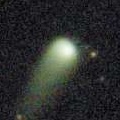
It was observed at 12-13 mag for a long time in 2024. Now it is 17.2 mag (May 17, ATLAS-HKO, Haleakala). It stays 18 mag for a while. In the Northern Hemisphere, it stays observable in good condition. It locates somewhat low in the Southern Hemisphere. Date(TT) R.A. (2000) Decl. Delta r Elong. m1 Best Time(A, h) June 6 23 13.09 31 30.5 6.641 6.449 74 17.3 3:01 (260, 49) June 13 23 11.45 31 46.1 6.583 6.493 80 17.3 2:58 (263, 55) |
C/2019 E3 ( ATLAS )
|
Very far object. It stays 17 mag for a while. In the Northern Hemisphere, it is not observable now, but it will appear in July. In the Southern Hemisphere, it stays observable in good condition. Date(TT) R.A. (2000) Decl. Delta r Elong. m1 Best Time(A, h) June 6 0 42.96 -42 29.6 11.445 11.439 87 17.4 3:01 (314,-11) June 13 0 43.50 -42 37.4 11.374 11.455 92 17.4 2:58 (317, -8) |
C/2025 V2 ( Rankin )
|
It is expected to brighten up to 12.5 mag in 2027 spring. Now it is 17.6 mag (May 21, ATLAS-HKO, Haleakala). Brightening slowly. It will be unobservable in August. But it will be observable again in October in the Northern Hemisphere. Date(TT) R.A. (2000) Decl. Delta r Elong. m1 Best Time(A, h) June 6 9 22.42 23 22.0 4.214 3.827 61 17.5 20:56 ( 98, 31) June 13 9 28.24 23 16.1 4.243 3.766 55 17.4 21:01 (102, 25) |
218P/LINEAR
|
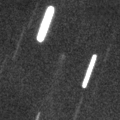
It will fade out rapidly after this. It will be fainter than 18 mag soon. In the Northern Hemisphere, it will be getting higher gradually. In the Southern Hemisphere, it stays observable in good condition. Date(TT) R.A. (2000) Decl. Delta r Elong. m1 Best Time(A, h) June 6 23 25.11 -1 24.6 1.359 1.602 83 17.6 3:01 (295, 29) June 13 23 33.65 -0 33.6 1.346 1.656 87 17.9 2:58 (298, 33) |
C/2023 F3 ( ATLAS )

|
Now it is 17.5 mag (May 17, Kunihiro Shima). It stays 18 mag for a while. In the Northern Hemisphere, it will be unobservable soon. In the Southern Hemisphere, it will be getting lower gradually. Date(TT) R.A. (2000) Decl. Delta r Elong. m1 Best Time(A, h) June 6 9 0.40 -5 43.7 6.670 6.331 66 17.6 20:56 ( 76, 10) June 13 9 1.35 -5 12.2 6.804 6.360 60 17.7 21:01 ( 81, 4) |
C/2023 H5 ( Lemmon )

|
Now it is 17.8 mag (May 25, Alfons Diepvens). It stays 18 mag for a while. In the Northern Hemisphere, it stays observable in good condition. In the Southern Hemisphere, it will never be observable after this. Date(TT) R.A. (2000) Decl. Delta r Elong. m1 Best Time(A, h) June 6 22 15.08 66 23.6 5.329 5.130 73 17.7 3:01 (202, 53) June 13 22 12.53 66 48.7 5.320 5.160 75 17.7 2:58 (198, 54) |
P/2012 K3 ( Gibbs )
|
|
It was observed at 17 mag in 2012. It was not recovered at the previous return in 2019. It stays 18 mag for a while. It stays observable in good condition. Now it is fainter than 20 mag (May 24, Jean-Francois Soulier). Date(TT) R.A. (2000) Decl. Delta r Elong. m1 Best Time(A, h) June 6 20 19.98 -11 4.5 1.326 2.123 129 17.9 3:01 (352, 44) June 13 20 22.45 -11 31.6 1.265 2.116 135 17.8 2:58 ( 0, 44) |
C/2026 C1 ( Tsuchinshan )
|
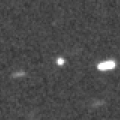
It is expected to brighten up to 4 mag in 2028 autumn. Now it is 17.3 mag (May 18, Alfons Diepvens). It stays 18 mag for a while. It will be getting lower gradually after this, and it will be unobservable in August in the Northern Hemisphere, or in September in the Southern Hemisphere. At the high light, it is observable in excellent condition in the Southern Hemisphere. In the Northern Hemisphere, it becomes observable after the perihelion passage. Date(TT) R.A. (2000) Decl. Delta r Elong. m1 Best Time(A, h) June 6 12 7.54 7 41.7 8.838 9.129 103 17.8 20:56 ( 48, 53) June 13 12 6.43 7 33.9 8.901 9.076 96 17.8 21:01 ( 58, 48) |
195P/Hill

|
Now it is 17.4 mag (May 21, ATLAS South Africa). It stays 18 mag for a while. It stays extremely low in the Northern Hemisphere. In the Southern Hemisphere, it will be getting lower gradually. Date(TT) R.A. (2000) Decl. Delta r Elong. m1 Best Time(A, h) June 6 9 43.77 -23 32.5 4.641 4.646 84 17.8 20:56 ( 55, 7) June 13 9 49.29 -23 10.3 4.733 4.655 79 17.9 21:01 ( 59, 2) |