Weekly Information about Bright Comets (2026 June 20: North)
|
Japanese version Home page |
Updated on June 24, 2026 |
|||
|
||||
|
Best time and the azimuth, altitude (A,h) are at lat. 35 deg in the Northern Hemisphere. Azimuth indicates 0 for south, 90 for west, 180 for north, 270 for east. |

|
|
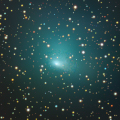
Now it is 9.3 mag (June 22, Virgilio Gonano). It brightens up to 8 mag, but it will turn to fade out rapidly after that. In the Northern Hemisphere, it will be getting lower gradually. In the Southern Hemisphere, it stays observable in good condition. Date(TT) R.A. (2000) Decl. Delta r Elong. m1 Best Time(A, h) June 20 20 44.76 -9 53.8 0.575 1.488 136 9.4 2:53 ( 0, 45) June 27 20 56.93 -11 14.0 0.530 1.468 141 9.1 2:38 ( 0, 44) |
 C/2025 R3 ( PanSTARRS )
|
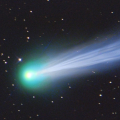
It brightened up to 4.0 mag in late April (Apr. 30, Chris Wyatt). It brightened up to 1.3 mag due to the forward scattering in the SOHO LASCO images (Apr. 25, Mikolaj Kaszczyk). Now it is 11.5 mag (June 15, Andrew Pearce). Fading rapidly. In the Northern Hemisphere, it is not observable now, but it will appear in August. It locates somewhat low in the Southern Hemisphere. But it will become high in autumn. Date(TT) R.A. (2000) Decl. Delta r Elong. m1 Best Time(A, h) June 20 6 57.65 -11 27.1 2.024 1.379 38 10.8 21:04 ( 98,-31) June 27 7 3.95 -11 52.5 2.180 1.494 36 11.4 21:04 (101,-36) |
88P/Howell
|
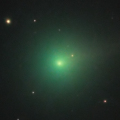
It brightened up to 9.6 mag in the very low sky in spring (Apr. 14, Chris Wyatt). Now it is 10.5 mag (June 22, Chris Wyatt). Fading gradually. In the Northern Hemisphere, it will be getting higher gradually. In the Southern Hemisphere, it stays observable in good condition. Date(TT) R.A. (2000) Decl. Delta r Elong. m1 Best Time(A, h) June 20 1 45.38 7 15.5 1.915 1.683 61 11.1 2:59 (273, 17) June 27 1 58.90 8 31.5 1.900 1.725 64 11.3 3:01 (275, 22) |
220P/McNaught
|
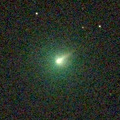
Major outburst of about 9 mag occured from May 31 to June 1, and it brightened up to 8.3 mag (June 3, Marco Goiato). Now it is 11.8 mag (June 22, Chris Wyatt). It will fade out rapidly after this. It will be fainter than 18 mag in September. In the Northern Hemisphere, it will be getting higher gradually. In the Southern Hemisphere, it stays observable in good condition. Date(TT) R.A. (2000) Decl. Delta r Elong. m1 Best Time(A, h) June 20 0 49.75 4 39.0 1.474 1.560 75 11.6 2:59 (284, 27) June 27 1 7.87 5 47.7 1.436 1.564 77 12.6 3:01 (285, 30) |
78P/Gehrels 2

|
Now it is 13.7 mag (June 21, Mike Olason). It stays 12 mag for a while. It locates somewhat low. But it will become high in summer in the Northern Hemisphere, or in autumn in the Southern Hemisphere. Date(TT) R.A. (2000) Decl. Delta r Elong. m1 Best Time(A, h) June 20 3 37.85 18 34.9 2.796 2.005 31 12.4 2:59 (248, 1) June 27 3 54.91 19 14.5 2.759 2.005 34 12.2 3:01 (249, 4) |
C/2023 R1 ( PanSTARRS )
|
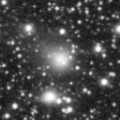
Now it is 12.6 mag (June 16, Toru Yusa). Fading slowly. In the Northern Hemisphere, it will be getting lower gradually after this, and it will be unobservable in October. In the Southern Hemisphere, it stays observable in good condition. Date(TT) R.A. (2000) Decl. Delta r Elong. m1 Best Time(A, h) June 20 17 17.02 -7 53.9 2.642 3.623 162 13.4 23:21 ( 0, 47) June 27 17 0.09 -8 39.0 2.684 3.634 155 13.4 22:37 ( 0, 46) |
C/2024 T5 ( ATLAS )
|
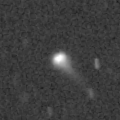
Now it is 13.9 mag (Mar. 12, ATLAS South Africa). Brightening slowly. In the Northern Hemisphere, it is not observable now, but it will appear in August. In the Southern Hemisphere, it will be getting higher gradually. It is expected to brighten up to 11 mag in winter. Date(TT) R.A. (2000) Decl. Delta r Elong. m1 Best Time(A, h) June 20 4 29.83 -15 0.2 5.415 4.729 43 13.6 2:59 (269,-29) June 27 4 36.75 -14 31.6 5.348 4.695 45 13.5 3:01 (271,-24) |
C/2024 J3 ( ATLAS )

|
Now it is 13.9 mag (June 12, Hiroshi Abe). It stays 14 mag for a while. In the Northern Hemisphere, it stays observable in good condition. It locates somewhat low in the Southern Hemisphere. Date(TT) R.A. (2000) Decl. Delta r Elong. m1 Best Time(A, h) June 20 20 3.76 34 31.7 3.581 4.104 114 13.7 2:13 ( 0, 90) June 27 19 56.87 36 22.2 3.532 4.084 116 13.6 1:38 (180, 89) |
P/2021 N1 ( ZTF )

|
First return of a new periodic comet which brightened up to 17 mag in 2021. It will approach to Earth down to 0.17 a.u. from June to July. It is expected to brighten up to 14 mag. Now it is 16.6 mag (June 22, ATLAS). It will turn to fade out rapidly after the peak. It will be fainter than 18 mag in October. In the Northern Hemisphere, it will be getting higher gradually. In the Southern Hemisphere, it will be getting lower gradually. Date(TT) R.A. (2000) Decl. Delta r Elong. m1 Best Time(A, h) June 20 23 5.30 -37 59.1 0.193 1.106 113 14.4 2:59 (334, 10) June 27 0 12.57 -22 53.9 0.173 1.063 100 14.0 3:01 (319, 19) |
29P/Schwassmann-Wachmann 1
|
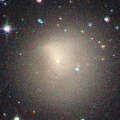
Now it is 13.8 mag (June 15, Toru Yusa). It will be unobservable in August in the Northern Hemisphere, or in September in the Southern Hemisphere. Date(TT) R.A. (2000) Decl. Delta r Elong. m1 Best Time(A, h) June 20 11 5.33 -1 11.9 6.420 6.316 79 14.0 21:04 ( 69, 25) June 27 11 7.81 -1 23.8 6.527 6.316 73 14.1 21:04 ( 73, 20) |
260P/McNaught
|
|
It will brighten up to 13 mag and will be observable in good condition from summer to autumn. Now it is 15.4 mag (June 13, Ken-ichi Kadota). Brightening slowly. In the Northern Hemisphere, it will be getting higher gradually. In the Southern Hemisphere, it will be getting lower gradually. Date(TT) R.A. (2000) Decl. Delta r Elong. m1 Best Time(A, h) June 20 1 3.66 2 41.9 1.457 1.508 72 14.7 2:59 (284, 23) June 27 1 22.53 5 53.0 1.402 1.484 73 14.4 3:01 (283, 27) |
C/2014 UN271 ( Bernardinelli-Bernstein )

|
Very large comet. It is expected to brighten up to 13 mag in 2031. Now it is 14.9 mag (May 19, Andrew Pearce). It stays 15 mag for a while. In the Northern Hemisphere, it is not observable now. In the Southern Hemisphere, it stays observable in good condition. In the Northern Hemisphere, it is not observable until 2030. Date(TT) R.A. (2000) Decl. Delta r Elong. m1 Best Time(A, h) June 20 6 5.21 -67 59.7 13.813 13.876 91 14.6 21:04 ( 24,-48) June 27 6 12.25 -68 0.4 13.794 13.855 91 14.6 3:01 (336,-48) |
63P/Wild 1
|
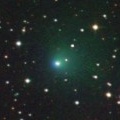
Now it is 14.4 mag (June 11, Toru Yusa). Fading slowly. It will be unobservable in July in the Northern Hemisphere, or in September in the Southern Hemisphere. Date(TT) R.A. (2000) Decl. Delta r Elong. m1 Best Time(A, h) June 20 9 25.16 20 19.0 2.491 1.981 49 14.7 21:04 (103, 17) June 27 9 40.01 18 11.5 2.536 1.977 46 14.6 21:04 (103, 13) |
141P/Machholz 2
|
|
The condition is very bad in this apparition. It is not observable at all. Fading rapidly. It will be fainter than 18 mag in July. It will never be observable after this. Date(TT) R.A. (2000) Decl. Delta r Elong. m1 Best Time(A, h) June 20 6 45.92 17 0.7 2.167 1.207 14 14.8 21:04 (123,-15) June 27 7 11.51 15 47.9 2.243 1.280 13 15.5 21:04 (123,-16) |
235P/LINEAR
|
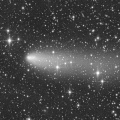
It became brighter than expected. Now it is 14.5 mag (June 15, Toru Yusa). It will fade out rapidly after this. It will be fainter than 18 mag in August. It stays observable in good condition. Date(TT) R.A. (2000) Decl. Delta r Elong. m1 Best Time(A, h) June 20 16 43.92 -8 6.2 1.435 2.405 157 15.1 22:49 ( 0, 47) June 27 16 40.14 -8 4.8 1.492 2.433 151 15.4 22:18 ( 0, 47) |
C/2024 R4 ( PanSTARRS )
|
Now it is 15.2 mag (June 12, Ken-ichi Kadota). It stays 15 mag for a while. In the Northern Hemisphere, it stays observable in good condition. It stays extremely low in the Southern Hemisphere. Date(TT) R.A. (2000) Decl. Delta r Elong. m1 Best Time(A, h) June 20 22 4.11 42 33.5 5.781 5.909 92 15.2 2:59 (237, 74) June 27 21 59.37 43 48.6 5.673 5.874 96 15.2 3:01 (218, 78) |
C/2022 QE78 ( ATLAS )
|
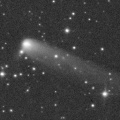
Now it is 15.5 mag (June 14, Alfons Diepvens). It stays 15 mag for a while. It will be unobservable in July in the Southern Hemisphere, or in August in the Northern Hemisphere. But it will be observable again in September in the Northern Hemisphere. Date(TT) R.A. (2000) Decl. Delta r Elong. m1 Best Time(A, h) June 20 9 38.70 30 38.3 6.445 5.849 50 15.2 21:04 (111, 25) June 27 9 44.32 30 21.2 6.537 5.867 45 15.3 21:04 (113, 20) |
C/2021 G2 ( ATLAS )

|
Now it is 14.9 mag (June 11, Toru Yusa). It stays 16 mag for a while. It stays observable in good condition. Date(TT) R.A. (2000) Decl. Delta r Elong. m1 Best Time(A, h) June 20 17 10.06 15 49.2 6.142 6.945 139 15.4 23:15 ( 0, 71) June 27 17 7.45 15 58.6 6.205 6.979 136 15.4 22:45 ( 0, 71) |
123P/West-Hartley

|
Now it is 17.6 mag (May 17, Kunihiro Shima). It stays 15 mag for a while. In the Northern Hemisphere, it will be unobservable soon. But it will be observable again in September. In the Southern Hemisphere, it is not observable now. Date(TT) R.A. (2000) Decl. Delta r Elong. m1 Best Time(A, h) June 20 7 18.98 32 27.5 3.197 2.277 21 15.6 21:04 (130, 1) June 27 7 36.03 31 57.8 3.202 2.261 18 15.5 21:04 (131, -1) |
C/2022 N2 ( PanSTARRS )
|
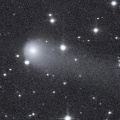
Now it is 15.8 mag (May 7, Ken-ichi Kadota). It stays 16 mag for a while. Now it is not observable. It will appear in July in the Northern Hemisphere, or in August in the Southern Hemisphere. Date(TT) R.A. (2000) Decl. Delta r Elong. m1 Best Time(A, h) June 20 5 48.40 27 0.8 5.748 4.735 3 15.6 2:59 (221,-15) June 27 5 56.79 27 0.2 5.777 4.769 6 15.6 3:01 (225,-12) |
93P/Lovas 1
|
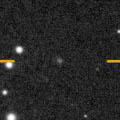
Now it is 16.0 mag (Jan. 18, Kunihiro Shima). Fading slowly. Now it is not observable. It will appear in August in the Northern Hemisphere, or in October in the Southern Hemisphere. Date(TT) R.A. (2000) Decl. Delta r Elong. m1 Best Time(A, h) June 20 5 32.49 30 53.4 2.758 1.760 8 15.9 2:59 (221, -9) June 27 5 54.59 30 57.3 2.775 1.781 9 16.0 3:01 (223, -8) |
169P/NEAT
|
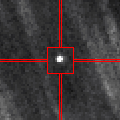
It will approach to Earth down to 0.17 a.u. in August. It is expected to brighten up to 10 mag from August to September. Now it is 15.8 mag (June 17, Alfons Diepvens). Brightening rapidly. It will be getting lower gradually after this, and it will be unobservable in August. But it will be observable again in in the Northern Hemisphere, or in September in the Southern Hemisphere. Date(TT) R.A. (2000) Decl. Delta r Elong. m1 Best Time(A, h) June 20 19 32.82 5 37.2 0.676 1.604 142 16.6 1:42 ( 0, 61) June 27 19 27.02 8 22.8 0.576 1.522 144 16.1 1:09 ( 0, 63) |
24P/Schaumasse

|
It brightened up to 8.4 mag in January (Jan. 14, Mitsunori Tsumura). Now it is 15.2 mag (June 15, Toru Yusa). Fading rapidly. It will be fainter than 18 mag in July. In the Northern Hemisphere, it will be getting lower gradually. In the Southern Hemisphere, it stays observable in good condition. Date(TT) R.A. (2000) Decl. Delta r Elong. m1 Best Time(A, h) June 20 14 17.10 -6 38.3 1.511 2.260 125 16.3 21:04 ( 15, 47) June 27 14 19.54 -7 44.7 1.637 2.319 120 16.7 21:04 ( 23, 44) |
C/2025 Y1 ( ATLAS )
|
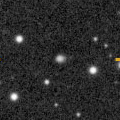
Now it is 16.1 mag (June 14, Erik Bryssinck). It stays 16 mag for a while. It will be getting lower gradually after this, and it will be unobservable in September. Date(TT) R.A. (2000) Decl. Delta r Elong. m1 Best Time(A, h) June 20 12 40.18 4 33.7 5.108 5.362 98 16.3 21:04 ( 54, 46) June 27 12 41.20 4 24.1 5.164 5.309 92 16.3 21:04 ( 61, 41) |
C/2024 G6 ( ATLAS )
|
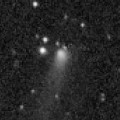
Now it is 16.6 mag (May 26, ATLAS-HKO, Haleakala). It stays 17 mag for a while. In the Northern Hemisphere, it stays observable in good condition. In the Southern Hemisphere, it will be getting lower gradually after this, and it will be unobservable in October. Date(TT) R.A. (2000) Decl. Delta r Elong. m1 Best Time(A, h) June 20 15 28.49 14 25.2 5.802 6.481 128 16.6 21:34 ( 0, 69) June 27 15 23.83 14 49.0 5.889 6.487 122 16.6 21:04 ( 2, 70) |
C/2022 R6 ( PanSTARRS )
|
Now it is 16.6 mag (June 15, Andrew Pearce). It stays 17 mag for a while. It will be unobservable soon in the Northern Hemisphere, or in August in the Southern Hemisphere. But it will be observable again in September. Date(TT) R.A. (2000) Decl. Delta r Elong. m1 Best Time(A, h) June 20 8 57.18 4 25.8 7.495 6.862 48 16.7 21:04 ( 94, 2) June 27 9 1.36 4 39.8 7.587 6.875 42 16.8 21:04 ( 97, -2) |
C/2025 M2 ( PanSTARRS )
|
It is expected to brighten up to 12 mag from 2027 to 2028. Now it is 16.8 mag (June 13, ATLAS-HKO, Haleakala). It stays 17 mag for a while. It stays observable in good condition. Date(TT) R.A. (2000) Decl. Delta r Elong. m1 Best Time(A, h) June 20 20 38.99 -17 47.1 4.840 5.664 140 17.0 2:48 ( 0, 37) June 27 20 32.04 -18 7.6 4.715 5.612 149 16.9 2:14 ( 0, 37) |
C/2026 A2 ( Bok )
|
It will brighten up to 14 mag from autumn to winter. Now it is 16.9 mag (June 17, Jean-Gabriel Bosch). Brightening gradually. In the Northern Hemisphere, it stays observable in good condition. In the Southern Hemisphere, it is not observable now. Date(TT) R.A. (2000) Decl. Delta r Elong. m1 Best Time(A, h) June 20 17 49.18 77 19.8 2.939 2.925 79 17.0 23:51 (180, 48) June 27 17 30.82 78 14.7 2.898 2.867 78 16.9 23:04 (180, 47) |
65P/Gunn
|
Now it is 18.0 mag (May 24, Andrew Pearce). It stays 17 mag for a while. In the Northern Hemisphere, it will be getting higher gradually. In the Southern Hemisphere, it stays observable in good condition. Date(TT) R.A. (2000) Decl. Delta r Elong. m1 Best Time(A, h) June 20 0 36.35 -5 42.3 3.385 3.403 82 17.0 2:59 (295, 23) June 27 0 41.13 -5 24.9 3.303 3.418 87 16.9 3:01 (300, 28) |
C/2024 G4 ( PanSTARRS )

|
Now it is 17.1 mag (June 11, ATLAS-MLO, Mauna Loa). It stays 17 mag for a while. It stays observable in good condition. Date(TT) R.A. (2000) Decl. Delta r Elong. m1 Best Time(A, h) June 20 20 21.27 4 2.8 4.184 4.951 134 17.1 2:30 ( 0, 59) June 27 20 19.81 3 47.5 4.132 4.959 140 17.0 2:01 ( 0, 59) |
C/2025 E1 ( PanSTARRS )
|
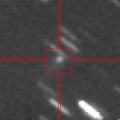
Now it is 17.2 mag (June 2, ATLAS Chile). It stays 17 mag for a while. In the Northern Hemisphere, it will never be observable after this. In the Southern Hemisphere, it will be getting lower gradually. Date(TT) R.A. (2000) Decl. Delta r Elong. m1 Best Time(A, h) June 20 8 42.77 -62 40.9 3.910 4.082 92 17.1 21:04 ( 33,-32) June 27 8 48.32 -62 41.2 3.927 4.070 90 17.1 21:04 ( 33,-35) |
C/2025 Q3 ( ATLAS )

|
It brightened up to 14.1 mag in early 2026 (Jan. 16, Kunihiro Shima). Now it is 18.5 mag (June 13, John Drummond). It will fade out rapidly after this. It will be fainter than 18 mag in July. In the Northern Hemisphere, it will never be observable after this. It locates somewhat low in the Southern Hemisphere. Date(TT) R.A. (2000) Decl. Delta r Elong. m1 Best Time(A, h) June 20 5 40.86 -40 46.3 2.764 2.497 64 17.1 2:59 (293,-53) June 27 6 0.05 -42 47.6 2.771 2.540 66 17.3 3:01 (297,-51) |
C/2025 A6 ( Lemmon )
|
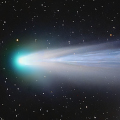
It brightened up to 3.7 mag in late October (Oct. 26, Juan Jose Gonzalez). Now it is 16.7 mag (June 12, ATLAS-HKO, Haleakala). It will fade out rapidly after this. It will be fainter than 18 mag in July. In the Northern Hemisphere, it will never be observable after this. In the Southern Hemisphere, it will be getting lower gradually. Date(TT) R.A. (2000) Decl. Delta r Elong. m1 Best Time(A, h) June 20 10 49.76 -34 45.0 3.413 3.582 91 17.2 21:04 ( 46, -1) June 27 10 52.34 -33 34.6 3.595 3.664 85 17.6 21:04 ( 51, -4) |
C/2022 E2 ( ATLAS )
|
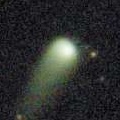
It was observed at 12-13 mag for a long time in 2024. Now it is 16.9 mag (June 13, ATLAS-MLO, Mauna Loa). It stays 18 mag for a while. In the Northern Hemisphere, it stays observable in good condition. It locates somewhat low in the Southern Hemisphere. Date(TT) R.A. (2000) Decl. Delta r Elong. m1 Best Time(A, h) June 20 23 9.24 31 59.3 6.522 6.537 86 17.3 2:59 (266, 61) June 27 23 6.44 32 9.2 6.461 6.581 92 17.3 3:01 (269, 68) |
C/2019 E3 ( ATLAS )
|
Very far object. It stays 17 mag for a while. In the Northern Hemisphere, it is not observable now, but it will appear in July. In the Southern Hemisphere, it stays observable in good condition. Date(TT) R.A. (2000) Decl. Delta r Elong. m1 Best Time(A, h) June 20 0 43.71 -42 47.4 11.303 11.471 96 17.4 2:59 (321, -4) June 27 0 43.58 -42 59.4 11.234 11.487 101 17.4 3:01 (325, -1) |
C/2023 X2 ( Lemmon )
|
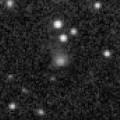
Now it is 17.0 mag (May 17, Kunihiro Shima). It stays 18 mag for a while. In the Northern Hemisphere, it stays observable in good condition. In the Southern Hemisphere, it will never be observable after this. Date(TT) R.A. (2000) Decl. Delta r Elong. m1 Best Time(A, h) June 20 13 17.51 80 13.4 5.510 5.257 70 17.4 21:04 (174, 44) June 27 13 20.61 78 31.0 5.531 5.271 70 17.4 21:04 (171, 45) |
P/2012 K3 ( Gibbs )
|
|
It was observed at 17 mag in 2012. It was not recovered at the previous return in 2019. Fading slowly. It will be fainter than 18 mag in September. It stays observable in good condition. Now it is fainter than 20 mag (May 24, Jean-Francois Soulier). Date(TT) R.A. (2000) Decl. Delta r Elong. m1 Best Time(A, h) June 20 20 23.59 -12 10.3 1.212 2.111 142 17.7 2:33 ( 0, 43) June 27 20 23.43 -13 0.9 1.167 2.106 149 17.6 2:05 ( 0, 42) |
C/2023 H5 ( Lemmon )

|
Now it is 17.4 mag (June 10, Alfons Diepvens). It stays 18 mag for a while. In the Northern Hemisphere, it stays observable in good condition. In the Southern Hemisphere, it will never be observable after this. Date(TT) R.A. (2000) Decl. Delta r Elong. m1 Best Time(A, h) June 20 22 8.54 67 10.0 5.308 5.190 77 17.7 2:59 (193, 56) June 27 22 3.12 67 26.0 5.292 5.221 80 17.8 3:01 (187, 57) |
C/2023 F3 ( ATLAS )

|
Now it is 17.5 mag (May 17, Kunihiro Shima). It stays 18 mag for a while. In the Northern Hemisphere, it will never be observable after this. It locates somewhat low in the Southern Hemisphere. Date(TT) R.A. (2000) Decl. Delta r Elong. m1 Best Time(A, h) June 20 9 2.61 -4 45.1 6.931 6.389 54 17.8 21:04 ( 85, -2) June 27 9 4.13 -4 21.9 7.050 6.419 48 17.8 21:04 ( 89, -7) |
161P/Hartley-IRAS
|
|
It is expected to brighten up 10 mag from autumn to winter, and it will be observable in good condition. It has not been observed yet in this apparition. It will brighten rapidly after this. In the Northern Hemisphere, it is not observable now, but it will appear in July. In the Southern Hemisphere, it stays observable in good condition. Date(TT) R.A. (2000) Decl. Delta r Elong. m1 Best Time(A, h) June 20 3 5.67 -23 10.6 2.710 2.403 61 18.1 2:59 (287,-16) June 27 3 9.96 -22 23.1 2.571 2.337 65 17.8 3:01 (290,-11) |
C/2026 C1 ( Tsuchinshan )
|
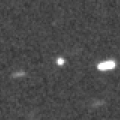
It is expected to brighten up to 4 mag in 2028 autumn. Now it is 17.8 mag (June 16, M. Camarasa). It stays 18 mag for a while. It will be getting lower gradually after this, and it will be unobservable in August in the Northern Hemisphere, or in September in the Southern Hemisphere. But it will be observable again in October in the Northern Hemisphere. At the high light, it is observable in excellent condition in the Southern Hemisphere. In the Northern Hemisphere, it becomes observable after the perihelion passage. Date(TT) R.A. (2000) Decl. Delta r Elong. m1 Best Time(A, h) June 20 12 5.67 7 24.1 8.966 9.023 89 17.8 21:04 ( 65, 42) June 27 12 5.25 7 12.2 9.031 8.970 83 17.8 21:04 ( 71, 36) |