Weekly Information about Bright Comets (2026 Aug. 1: South)
|
Japanese version Home page |
Updated on August 1, 2026 |
|||
|
||||
|
Best time and the azimuth, altitude (A,h) are at lat. 35 deg in the Southern Hemisphere. Azimuth indicates 0 for south, 90 for west, 180 for north, 270 for east. |

|
|
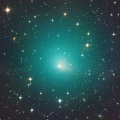
Now it is 8.0 mag (July 26, Virgilio Gonano). It will fade out rapidly after this. It locates somewhat low in the Northern Hemisphere. But it will become high in autumn. In the Southern Hemisphere, it stays observable in good condition. Date(TT) R.A. (2000) Decl. Delta r Elong. m1 Best Time(A, h) Aug. 1 21 49.93 -24 8.9 0.415 1.418 163 8.0 1:13 (180, 79) Aug. 8 21 58.20 -27 12.1 0.416 1.419 164 8.0 0:54 (180, 82) |
 169P/NEAT
|
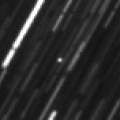
It will approach to Earth down to 0.17 a.u. in August. It is expected to brighten up to 10 mag from August to September. Now it is 14.4 mag (July 21, Andrew Pearce). It brightens up to 10 mag, but it will turn to fade out rapidly after that. It will be fainter than 18 mag in November. It will be unobservable soon. But it will be observable again in September. Date(TT) R.A. (2000) Decl. Delta r Elong. m1 Best Time(A, h) Aug. 1 17 4.23 34 2.5 0.205 1.090 106 13.1 20:19 (180, 20) Aug. 8 15 17.69 40 49.2 0.172 1.001 80 12.0 18:49 (171, 13) |
88P/Howell
|
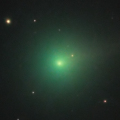
It brightened up to 9.6 mag in the very low sky in spring (Apr. 14, Chris Wyatt). Now it is 12.5 mag (July 24, Hiroshi Abe). Fading gradually. It stays observable in good condition. Date(TT) R.A. (2000) Decl. Delta r Elong. m1 Best Time(A, h) Aug. 1 2 52.93 13 5.9 1.777 1.948 83 12.2 5:27 (196, 40) Aug. 8 3 0.54 13 40.7 1.744 1.994 88 12.4 5:22 (191, 41) |
C/2024 T5 ( ATLAS )
|
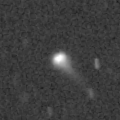
Now it is 13.9 mag (July 24, Andrew Pearce). Brightening slowly. In the Northern Hemisphere, it will be getting higher gradually. In the Southern Hemisphere, it stays observable in good condition. It is expected to brighten up to 11 mag in winter. Date(TT) R.A. (2000) Decl. Delta r Elong. m1 Best Time(A, h) Aug. 1 5 9.17 -13 5.0 4.931 4.533 61 13.1 5:27 (254, 43) Aug. 8 5 14.96 -12 58.2 4.834 4.502 65 13.0 5:22 (251, 46) |
260P/McNaught
|
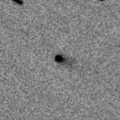
Now it is 13.5 mag (July 13, Kunihiro Shima). Fading slowly. In the Northern Hemisphere, it stays observable in good condition. It locates somewhat low in the Southern Hemisphere. Date(TT) R.A. (2000) Decl. Delta r Elong. m1 Best Time(A, h) Aug. 1 3 1.11 22 2.7 1.197 1.419 79 13.3 5:27 (195, 31) Aug. 8 3 21.51 25 4.9 1.169 1.418 80 13.2 5:22 (194, 28) |
78P/Gehrels 2

|
Now it is 13.6 mag (July 24, Hiroshi Abe). It stays 13 mag for a while. In the Northern Hemisphere, it will be getting higher gradually. It locates somewhat low in the Southern Hemisphere. But it will become high in autumn. Date(TT) R.A. (2000) Decl. Delta r Elong. m1 Best Time(A, h) Aug. 1 5 18.95 20 45.7 2.560 2.027 48 13.2 5:27 (227, 18) Aug. 8 5 35.06 20 42.3 2.516 2.037 51 13.2 5:22 (226, 19) |
C/2025 R3 ( PanSTARRS )
|
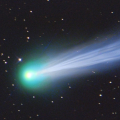
It brightened up to 4.0 mag in late April (Apr. 30, Chris Wyatt). It brightened up to 1.3 mag due to the forward scattering in the SOHO LASCO images (Apr. 25, Mikolaj Kaszczyk). Now it is 12.6 mag (June 23, Andrew Pearce). Fading gradually. In the Northern Hemisphere, it is not observable now, but it will appear in September. In the Southern Hemisphere, it will be getting higher gradually. Date(TT) R.A. (2000) Decl. Delta r Elong. m1 Best Time(A, h) Aug. 1 7 27.46 -15 11.3 2.735 2.037 38 13.3 5:27 (278, 16) Aug. 8 7 30.72 -16 6.4 2.804 2.140 40 13.6 5:22 (276, 20) |
C/2024 J3 ( ATLAS )
|
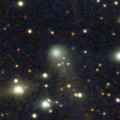
Now it is 13.7 mag (July 14, Kunihiro Shima). It stays 14 mag for a while. In the Northern Hemisphere, it stays observable in good condition. In the Southern Hemisphere, it will be unobservable in October. Date(TT) R.A. (2000) Decl. Delta r Elong. m1 Best Time(A, h) Aug. 1 19 12.52 42 33.1 3.449 3.997 115 13.5 22:31 (180, 12) Aug. 8 19 3.41 43 4.7 3.462 3.982 113 13.5 21:55 (180, 12) |
C/2023 R1 ( PanSTARRS )
|
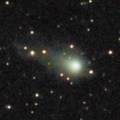
Now it is 13.3 mag (July 19, Toru Yusa). Fading slowly. It will be getting lower gradually after this, and it will be unobservable in October in the Northern Hemisphere, or in November in the Southern Hemisphere. Date(TT) R.A. (2000) Decl. Delta r Elong. m1 Best Time(A, h) Aug. 1 15 55.92 -12 15.0 3.222 3.706 110 13.9 19:16 (180, 67) Aug. 8 15 48.04 -12 54.8 3.371 3.724 102 14.0 18:49 (175, 68) |
220P/McNaught
|
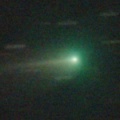
Major outburst of about 9 mag occured from May 31 to June 1, and it brightened up to 8.3 mag (June 3, Marco Goiato). Now it is 13.3 mag (July 21, Osamu Miyazaki). Fading rapidly. It will be fainter than 18 mag in October. It stays observable in good condition. Date(TT) R.A. (2000) Decl. Delta r Elong. m1 Best Time(A, h) Aug. 1 2 29.15 9 18.7 1.263 1.626 90 13.9 5:27 (189, 45) Aug. 8 2 42.66 9 31.0 1.231 1.647 93 14.4 5:22 (186, 45) |
29P/Schwassmann-Wachmann 1
|
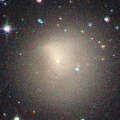
Now it is 14.1 mag (July 27, Andrew Pearce). In the Northern Hemisphere, it is not observable now, but it will appear in October. In the Southern Hemisphere, it will be unobservable in September. But it will be observable again in November. Date(TT) R.A. (2000) Decl. Delta r Elong. m1 Best Time(A, h) Aug. 1 11 24.73 -2 58.1 6.994 6.317 45 14.2 18:45 (106, 26) Aug. 8 11 28.82 -3 23.0 7.067 6.318 39 14.3 18:49 (101, 21) |
63P/Wild 1
|
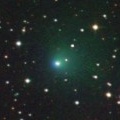
Now it is 14.8 mag (July 5, Martin Masek). Fading gradually. In the Northern Hemisphere, it is not observable now. In the Southern Hemisphere, it will be unobservable in September. Date(TT) R.A. (2000) Decl. Delta r Elong. m1 Best Time(A, h) Aug. 1 10 52.91 7 0.5 2.758 1.991 33 14.6 18:45 (109, 14) Aug. 8 11 7.23 4 43.0 2.802 2.001 30 14.6 18:49 (104, 12) |
C/2014 UN271 ( Bernardinelli-Bernstein )

|
Very large comet. It is expected to brighten up to 13 mag in 2031. Now it is 14.9 mag (May 19, Andrew Pearce). It stays 15 mag for a while. In the Northern Hemisphere, it is not observable now. In the Southern Hemisphere, it stays observable in good condition. In the Northern Hemisphere, it is not observable until 2030. Date(TT) R.A. (2000) Decl. Delta r Elong. m1 Best Time(A, h) Aug. 1 6 46.96 -68 39.1 13.726 13.751 89 14.6 5:27 (334, 39) Aug. 8 6 53.58 -68 53.5 13.717 13.730 88 14.6 5:22 (334, 41) |
C/2024 R4 ( PanSTARRS )
|
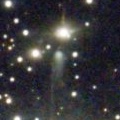
Now it is 14.9 mag (July 11, Alfons Diepvens). It stays 15 mag for a while. In the Northern Hemisphere, it stays observable in good condition. In the Southern Hemisphere, it will be unobservable in November. Date(TT) R.A. (2000) Decl. Delta r Elong. m1 Best Time(A, h) Aug. 1 21 21.14 48 40.0 5.233 5.701 112 14.9 0:45 (180, 6) Aug. 8 21 11.08 49 11.9 5.171 5.667 114 14.8 0:07 (180, 6) |
123P/West-Hartley

|
Now it is 16.9 mag (May 17, Kunihiro Shima). It stays 15 mag for a while. Now it is not observable. It will appear in September in the Northern Hemisphere, or in November in the Southern Hemisphere. Date(TT) R.A. (2000) Decl. Delta r Elong. m1 Best Time(A, h) Aug. 1 9 1.25 27 49.5 3.186 2.196 10 15.2 18:45 (111,-20) Aug. 8 9 17.96 26 41.5 3.176 2.187 10 15.2 18:49 (108,-22) |
C/2026 A2 ( Bok )
|
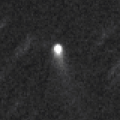
It will brighten up to 13 mag from autumn to winter. Now it is 15.6 mag (July 20, Toru Yusa). Brightening gradually. In the Northern Hemisphere, it stays observable in good condition. In the Southern Hemisphere, it is not observable now, but it will appear in November. Date(TT) R.A. (2000) Decl. Delta r Elong. m1 Best Time(A, h) Aug. 1 16 7.47 78 27.0 2.636 2.591 76 15.5 19:25 (180,-23) Aug. 8 16 3.12 77 51.5 2.570 2.538 76 15.3 18:54 (180,-23) |
161P/Hartley-IRAS

|
It is expected to brighten up 10 mag from autumn to winter, and it will be observable in good condition. Now it is 17.3 mag (July 25, ATLAS-HKO, Haleakala). Brightening rapidly. In the Northern Hemisphere, it will be getting higher gradually. In the Southern Hemisphere, it will be getting lower gradually after this, and it will be unobservable in November. Date(TT) R.A. (2000) Decl. Delta r Elong. m1 Best Time(A, h) Aug. 1 3 21.74 -19 38.5 1.778 2.008 87 15.8 5:27 (233, 67) Aug. 8 3 20.51 -19 18.9 1.605 1.943 93 15.3 5:22 (221, 70) |
C/2022 QE78 ( ATLAS )
|
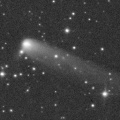
Now it is 15.5 mag (June 14, Alfons Diepvens). It stays 16 mag for a while. In the Northern Hemisphere, it will be unobservable soon. But it will be observable again in September. In the Southern Hemisphere, it is not observable now, but it will appear in November. Date(TT) R.A. (2000) Decl. Delta r Elong. m1 Best Time(A, h) Aug. 1 10 14.99 28 47.5 6.879 5.962 23 15.4 18:45 (121, -7) Aug. 8 10 21.44 28 28.5 6.922 5.982 20 15.5 18:49 (117,-11) |
C/2021 G2 ( ATLAS )

|
Now it is 15.5 mag (July 13, Martin Masek). It stays 16 mag for a while. In the Northern Hemisphere, it stays observable in good condition. In the Southern Hemisphere, it will be getting lower gradually after this, and it will be unobservable in November. Date(TT) R.A. (2000) Decl. Delta r Elong. m1 Best Time(A, h) Aug. 1 16 58.68 15 37.8 6.662 7.153 115 15.7 20:19 (180, 39) Aug. 8 16 58.08 15 23.2 6.775 7.188 110 15.8 19:51 (180, 40) |
C/2022 N2 ( PanSTARRS )
|
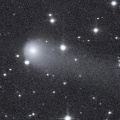
Now it is 15.8 mag (May 7, Ken-ichi Kadota). It stays 16 mag for a while. In the Northern Hemisphere, it will be getting higher gradually. It stays extremely low in the Southern Hemisphere. Date(TT) R.A. (2000) Decl. Delta r Elong. m1 Best Time(A, h) Aug. 1 6 36.10 26 39.7 5.795 4.948 30 15.8 5:27 (236, 1) Aug. 8 6 43.24 26 32.8 5.774 4.984 35 15.8 5:22 (234, 4) |
(3200) Phaethon

|
Parent object of Geminids meteor shower. It approaches to Sun down to 0.14 a.u. on Sept. 2. In the Northern Hemisphere, it will be observable at 14-15 mag in good condition in October. Now it is not observable. It will appear in September in the Northern Hemisphere, or in October in the Southern Hemisphere. Date(TT) R.A. (2000) Decl. Delta r Elong. m1 Best Time(A, h) Aug. 1 7 20.05 22 5.3 1.768 0.884 19 16.4 5:27 (246, -4) Aug. 8 7 52.49 19 54.5 1.633 0.749 18 15.9 5:22 (249, -5) |
C/2025 Y1 ( ATLAS )
|
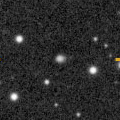
Now it is 16.0 mag (July 27, ATLAS South Africa). It stays 16 mag for a while. It will be unobservable in September. But it will be observable again in November in the Northern Hemisphere. Date(TT) R.A. (2000) Decl. Delta r Elong. m1 Best Time(A, h) Aug. 1 12 54.02 2 48.7 5.421 5.045 63 16.2 18:45 (129, 39) Aug. 8 12 57.99 2 22.0 5.461 4.993 57 16.2 18:49 (122, 34) |
P/2026 M1 ( ZTF )
|
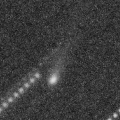
First return of a new periodic comet which brightened up to 17 mag in 2021. It approached to Earth down to 0.17 a.u. from June to July. It brightened up to 15.2 mag (July 14, Andrew Pearce). Now it is 16.3 mag (July 19, ATLAS-MLO, Mauna Loa). It will fade out rapidly after this. It will be fainter than 18 mag in September. In the Northern Hemisphere, it stays observable in good condition. It stays extremely low in the Southern Hemisphere. Date(TT) R.A. (2000) Decl. Delta r Elong. m1 Best Time(A, h) Aug. 1 3 20.98 33 50.7 0.328 0.968 72 16.4 5:27 (197, 19) Aug. 8 3 43.08 37 33.8 0.376 0.978 73 16.8 5:22 (196, 15) |
C/2025 M2 ( PanSTARRS )
|
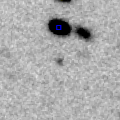
It is expected to brighten up to 12 mag from 2027 to 2028. Now it is 16.0 mag (July 25, ATLAS-HKO, Haleakala). It stays 16 mag for a while. It stays observable in good condition. Date(TT) R.A. (2000) Decl. Delta r Elong. m1 Best Time(A, h) Aug. 1 19 48.55 -19 57.5 4.361 5.354 166 16.5 23:08 (180, 75) Aug. 8 19 39.21 -20 16.3 4.348 5.302 158 16.4 22:31 (180, 75) |
65P/Gunn
|
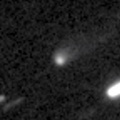
Now it is 18.4 mag (July 10, W. Hasubick). It stays 17 mag for a while. It stays observable in good condition. Date(TT) R.A. (2000) Decl. Delta r Elong. m1 Best Time(A, h) Aug. 1 0 54.14 -5 13.5 2.907 3.494 117 16.8 4:17 (180, 60) Aug. 8 0 54.24 -5 26.3 2.838 3.509 124 16.7 3:50 (180, 60) |
235P/LINEAR
|
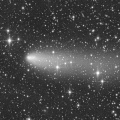
It became brighter than expected. It was observed at 13 mag from winter to spring. Now it is 17.4 mag (July 28, ATLAS-MLO, Mauna Loa). It will fade out rapidly after this. It will be fainter than 18 mag soon. It stays observable in good condition. Date(TT) R.A. (2000) Decl. Delta r Elong. m1 Best Time(A, h) Aug. 1 16 38.39 -9 34.6 1.915 2.579 120 16.8 19:59 (180, 65) Aug. 8 16 41.45 -10 4.2 2.019 2.609 114 17.1 19:35 (180, 65) |
C/2024 G6 ( ATLAS )
|
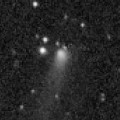
Now it is 16.8 mag (July 24, ATLAS-HKO, Haleakala). It stays 17 mag for a while. In the Northern Hemisphere, it will be getting lower gradually. But it will be getting higher again after November. In the Southern Hemisphere, it will be getting lower gradually after this, and it will be unobservable in October. Date(TT) R.A. (2000) Decl. Delta r Elong. m1 Best Time(A, h) Aug. 1 15 8.40 15 37.2 6.427 6.522 90 16.8 18:45 (175, 39) Aug. 8 15 6.98 15 36.8 6.542 6.531 84 16.9 18:49 (165, 38) |
114P/Wiseman-Skiff
|
|
It has not been observed yet in this apparition. It stays 17 mag for a while. In the Northern Hemisphere, it will be getting higher gradually. It stays extremely low in the Southern Hemisphere. But it will become high in autumn. Date(TT) R.A. (2000) Decl. Delta r Elong. m1 Best Time(A, h) Aug. 1 5 32.42 30 56.2 2.190 1.636 44 17.0 5:27 (223, 8) Aug. 8 5 55.67 30 20.7 2.140 1.618 46 16.8 5:22 (224, 8) |
C/2026 AZ17 ( Bok )

|
Now it is 17.0 mag (July 28, ATLAS-HKO, Haleakala). It stays 17 mag for a while. It stays observable in good condition. Date(TT) R.A. (2000) Decl. Delta r Elong. m1 Best Time(A, h) Aug. 1 16 22.03 20 53.0 2.311 2.754 105 16.9 19:43 (180, 34) Aug. 8 16 25.03 18 59.8 2.333 2.723 101 16.9 19:18 (180, 36) |
C/2024 G4 ( PanSTARRS )

|
Now it is 16.8 mag (July 10, Alfons Diepvens). It stays 18 mag for a while. It stays observable in good condition. Date(TT) R.A. (2000) Decl. Delta r Elong. m1 Best Time(A, h) Aug. 1 20 8.65 1 10.7 4.047 5.007 158 17.0 23:28 (180, 54) Aug. 8 20 6.37 0 26.0 4.069 5.018 157 17.1 22:59 (180, 55) |
C/2025 E1 ( PanSTARRS )
|
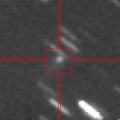
Now it is 17.2 mag (June 2, ATLAS Chile). It stays 17 mag for a while. In the Northern Hemisphere, it will never be observable after this. It locates somewhat low in the Southern Hemisphere. Date(TT) R.A. (2000) Decl. Delta r Elong. m1 Best Time(A, h) Aug. 1 9 29.43 -64 58.6 4.009 4.025 83 17.1 18:45 ( 30, 32) Aug. 8 9 40.30 -65 52.5 4.025 4.018 82 17.1 18:49 ( 28, 30) |
C/2023 RS61 ( PanSTARRS )
|
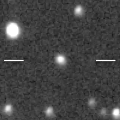
It is around 20 mag usually. However, it brightened in outburst in 2025 autumn up to 17.0 mag (Sept. 4, Taras Prystavski). Now it is 17.3 mag (Mar. 6, ATLAS-HKO, Haleakala). It stays 17 mag for a while. In the Northern Hemisphere, it stays observable in good condition. It stays extremely low in the Southern Hemisphere. Date(TT) R.A. (2000) Decl. Delta r Elong. m1 Best Time(A, h) Aug. 1 4 23.36 40 18.0 8.985 8.514 59 17.3 5:27 (206, 8) Aug. 8 4 26.62 40 37.9 8.883 8.506 65 17.3 5:22 (203, 9) |
112P/Urata-Niijima
|
|
It has not been observed yet in this apparition. It is expected to brighten up to 15 mag in autumn. Now it is fainter than 19 mag (July 29, Jean-Francois Soulier). Brightening gradually. In the Northern Hemisphere, it stays observable in good condition. In the Southern Hemisphere, it will be getting lower gradually after this, and it will be unobservable in November. Date(TT) R.A. (2000) Decl. Delta r Elong. m1 Best Time(A, h) Aug. 1 3 46.41 14 5.3 1.546 1.548 70 17.6 5:27 (211, 35) Aug. 8 4 5.68 16 47.1 1.481 1.522 72 17.3 5:22 (209, 33) |
C/2019 E3 ( ATLAS )
|
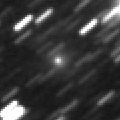
Very far object. It stays 17 mag for a while. It stays extremely low in the Northern Hemisphere. In the Southern Hemisphere, it stays observable in good condition. Date(TT) R.A. (2000) Decl. Delta r Elong. m1 Best Time(A, h) Aug. 1 0 37.30 -44 15.9 10.957 11.568 124 17.3 4:00 ( 0, 81) Aug. 8 0 34.91 -44 31.4 10.923 11.585 128 17.3 3:31 ( 0, 81) |
C/2022 E2 ( ATLAS )
|
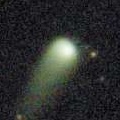
It was observed at 12-13 mag for a long time in 2024. Now it is 17.2 mag (July 10, Ken-ichi Kadota). It stays 18 mag for a while. In the Northern Hemisphere, it stays observable in good condition. It locates somewhat low in the Southern Hemisphere. Date(TT) R.A. (2000) Decl. Delta r Elong. m1 Best Time(A, h) Aug. 1 22 44.47 31 49.6 6.207 6.802 122 17.4 2:08 (180, 23) Aug. 8 22 38.83 31 28.0 6.179 6.847 127 17.4 1:35 (180, 23) |
C/2023 X2 ( Lemmon )
|
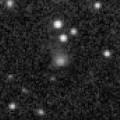
Now it is 17.8 mag (July 6, ATLAS-MLO, Mauna Loa). It stays 18 mag for a while. In the Northern Hemisphere, it stays observable in good condition. In the Southern Hemisphere, it will never be observable after this. Date(TT) R.A. (2000) Decl. Delta r Elong. m1 Best Time(A, h) Aug. 1 13 50.25 69 38.6 5.635 5.345 68 17.5 18:45 (172,-16) Aug. 8 13 57.46 67 51.8 5.657 5.362 68 17.5 18:49 (169,-15) |
188P/LINEAR-Mueller

|
Now it is 18.2 mag (Jan. 17, Kunihiro Shima). It stays 18 mag for a while. In the Northern Hemisphere, it stays observable in good condition. It stays extremely low in the Southern Hemisphere. Date(TT) R.A. (2000) Decl. Delta r Elong. m1 Best Time(A, h) Aug. 1 4 48.00 30 1.4 3.115 2.656 54 17.7 5:27 (216, 14) Aug. 8 4 59.99 30 39.8 3.057 2.670 58 17.6 5:22 (214, 15) |
C/2025 B2 ( Borisov )

|
Now it is 17.2 mag (July 20, ATLAS-MLO, Mauna Loa). It stays 18 mag for a while. In the Northern Hemisphere, it stays observable in good condition. In the Southern Hemisphere, it will never be observable after this. Date(TT) R.A. (2000) Decl. Delta r Elong. m1 Best Time(A, h) Aug. 1 16 52.30 85 0.5 8.455 8.243 74 17.7 20:05 (180,-30) Aug. 8 16 39.30 83 56.4 8.427 8.241 76 17.7 19:27 (180,-29) |
C/2023 H5 ( Lemmon )

|
Now it is 17.2 mag (July 8, ATLAS-MLO, Mauna Loa). It stays 18 mag for a while. In the Northern Hemisphere, it stays observable in good condition. In the Southern Hemisphere, it will never be observable after this. Date(TT) R.A. (2000) Decl. Delta r Elong. m1 Best Time(A, h) Aug. 1 21 20.56 66 42.9 5.199 5.381 94 17.8 0:44 (180,-12) Aug. 8 21 11.05 66 2.6 5.184 5.414 97 17.9 0:07 (180,-11) |
84P/Giclas
|
Now it is 17.4 mag (July 26, ATLAS South Africa). Brightening slowly. It locates somewhat low in the Northern Hemisphere. In the Southern Hemisphere, it stays observable in good condition. Date(TT) R.A. (2000) Decl. Delta r Elong. m1 Best Time(A, h) Aug. 1 20 44.51 -22 39.9 1.414 2.428 175 18.0 0:09 (180, 78) Aug. 8 20 38.21 -23 29.8 1.385 2.390 169 17.9 23:30 (180, 78) |
P/2026 L3 ( Gibbs )
|
|
It was observed at 17 mag in 2012. It was expected to brighten up to 17 mag again in this apparition. But actually, it is much fainter. Now it is 19.7 mag (July 14, Martin Masek). Fading gradually. In the Southern Hemisphere, it stays observable in good condition. Date(TT) R.A. (2000) Decl. Delta r Elong. m1 Best Time(A, h) Aug. 1 20 8.97 -19 23.1 1.095 2.105 171 20.9 23:29 (180, 74) Aug. 8 20 5.76 -20 44.5 1.115 2.109 164 21.0 22:58 (180, 76) |